

On a Tuesday morning in February 2026, a Bankstown resident realized the "standard" agreement they signed for a local service was actually designed to strip away their basic legal rights. It's a devastating moment when you discover a business deal wasn't just tough, it was predatory. If you're currently facing financial loss or emotional distress from an exploitative contract, you aren't alone in this struggle. Understanding your options for unconscionable conduct remedies is the first step toward restoring the balance you deserve and protecting your future.
We know that navigating the Australian Consumer Law can feel like a maze when you're already under significant pressure. You've worked hard for your financial security, and seeing it threatened by unfair practices is a burden no one should carry. This article provides a strategic checklist to help you identify how to void unfair contracts through rescission and pursue the financial damages you're owed. We'll show you exactly how to use these legal tools to secure your entitlements and reclaim your peace of mind.
Key Takeaways
- Identify the legal threshold where "hard bargaining" becomes oppressive, ensuring you know exactly when your rights have been violated in a business deal.
- Discover how various unconscionable conduct remedies work to reverse unfair contracts and return you to the financial position you held before the exploitation.
- Use our strategic checklist to gather the essential evidence needed to build a robust claim for your Bankstown-based business or personal agreement.
- Learn why local dispute resolution and the Bankstown Local Court are often more effective, community-focused paths to justice than high-stakes litigation.
- Gain peace of mind by understanding how a human-first legal defence provides a protective shield against the sophisticated tactics of aggressive corporations.
Recognising Unconscionable Conduct in Bankstown Contracts
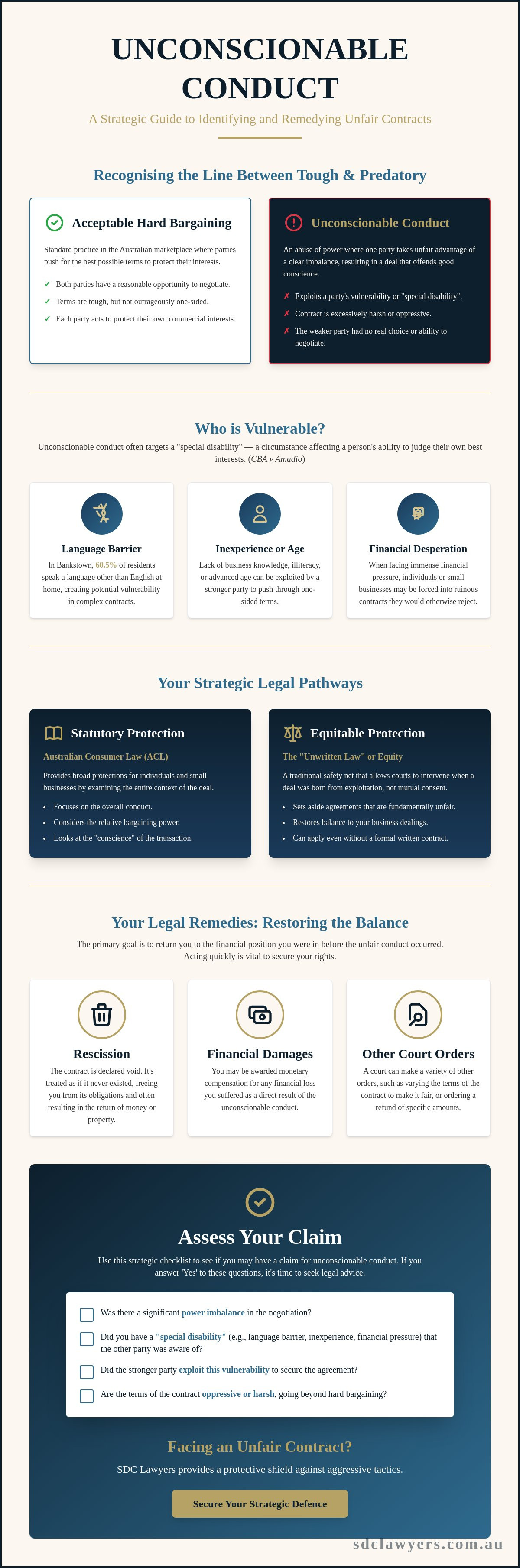
In the high-stakes environment of commercial negotiations, there's a thin line between aggressive business tactics and illegal exploitation. We often see Bankstown small business owners facing immense pressure from national franchises or large corporate landlords. The legal doctrine of unconscionability provides a vital shield when a contract is so harsh or oppressive that it offends good conscience. It's not just about a bad deal. It's about an abuse of power that the law refuses to ignore.
Hard bargaining is a standard part of the Australian marketplace. It involves parties pushing for the best possible terms to protect their interests. However, conduct becomes unconscionable when one party takes unfair advantage of a clear power imbalance. Seeking unconscionable conduct remedies becomes necessary when the stronger party ignores the other's vulnerability to secure a lopsided agreement. This often happens when a dominant entity uses its size to force terms that no reasonable person would accept if they had a real choice.
Bankstown small businesses are frequent targets for this behaviour. Large corporations may assume that local operators lack the resources or legal backing to challenge unfair terms. We've seen cases where financial desperation or a lack of alternative options is exploited to lock businesses into ruinous contracts. Our role is to act as a protective shield, ensuring that these power imbalances don't lead to your financial downfall.
Special Disability and the Bankstown Context
In our local community, the concept of "special disability" is particularly relevant. According to the 2021 Census, approximately 60.5% of Bankstown residents speak a language other than English at home. This linguistic diversity is a strength, yet in a legal setting, it can create a vulnerability if a person cannot fully understand a complex commercial lease or loan agreement. A special disability is a condition or circumstance that seriously affects the ability of the innocent party to make a judgment as to their own best interests, as established in the 1983 High Court case of Commercial Bank of Australia Ltd v Amadio.
Local context is everything when determining what is fair. What might be considered a standard clause in a corporate CBD office can be predatory when applied to a family-run grocery in Bankstown. If a landlord uses a tenant's age, illiteracy, or lack of business experience to push through a one-sided contract, the law provides a path to challenge those terms. You can find more detail in our Unconscionable Conduct in Bankstown: A Strategic Guide.
Statutory vs. Equitable Unconscionability
The Australian legal system offers two main pathways for protection. The Australian Consumer Law (ACL) provides statutory protections for both individuals and small businesses, focusing on the overall conduct and the relative bargaining power of the parties. It allows the court to look at the "conscience" of the transaction as a whole. On the other hand, the "Unwritten Law" or Equity acts as a traditional safety net for those without formal written contracts. These unconscionable conduct remedies allow the courts to set aside agreements that were born from exploitation rather than mutual consent, restoring balance to your business dealings.
Statutory vs. Equitable Remedies: Your Strategic Legal Options
When you've been exploited by a large institution or a predatory lender, the legal system offers a way back. The primary objective of unconscionable conduct remedies is simple: to return you to the position you occupied before the unfair conduct occurred. Choosing the right legal pathway isn't just a technicality. It's a strategic decision that determines whether you walk away with a cancelled debt, financial compensation, or a court-ordered change to your contract.
At SDC Lawyers, we don't believe in a one-size-fits-all approach. We analyze your specific hardship to identify the most robust remedy available. Whether you're a military veteran facing an insurance dispute or a local business owner in Bankstown pressured into an unfair deal, we act as your protective shield. Acting quickly is vital. Delay can lead to a loss of rights, especially when seeking to overturn a contract that's already being enforced. Under Australian law, the window for certain claims can close sooner than you might expect, making immediate action a priority for your peace of mind.
Equitable Remedies: Rescission and Injunctions
Equity focuses on fairness where the strict letter of the law might fail you. The most powerful tool here is rescission. This allows the court to "unmake" a contract as if it never existed. The legal term for this is Restitutio in Integrum, which refers to the restoration of the parties to their original state. We also use injunctions strategically. These are court orders that stop the other party from enforcing an unfair term, such as a foreclosure notice or an aggressive debt collection action, while your case is being heard. It's a vital defensive move to prevent further harm while we build your case.
Statutory Remedies under the ACL
The Australian Consumer Law provides a modern framework for seeking justice. Unlike equitable remedies that often focus on cancelling deals, statutory remedies allow for financial compensation, known as damages, to cover actual losses suffered. This is particularly useful if the conduct caused you specific financial harm that a simple cancellation won't fix. The court can also vary a contract. This means keeping the deal alive but rewriting the unfair terms to make them balanced and fair.
In larger Bankstown commercial disputes, the ACCC can intervene to seek civil penalties. These penalties serve as a deterrent against corporate bullying. If you're feeling overwhelmed by an unfair agreement, reaching out for a strategic consultation can help clarify which unconscionable conduct remedies apply to your situation. We're here to guide you through the legal wilderness and restore the balance of power in your favor.
The SDC Checklist: Assessing Your Eligibility for Legal Remedies
Determining if you're eligible for unconscionable conduct remedies involves more than just feeling wronged. It requires a strategic evaluation of the power dynamic during your transaction. In Bankstown's competitive 2026 commercial market, the line between aggressive negotiation and illegal exploitation can blur. This checklist helps you see through the complexity and decide if your situation warrants a formal legal claim.
Step 1: Identify the Special Disability
A special disability isn't limited to a medical condition. In a legal sense, it's any circumstance that seriously affects your ability to protect your own interests. Did the other party take advantage of a language barrier or your lack of independent legal advice? If you're a Bankstown small business owner who felt pressured into a contract without time for review, you must document every interaction. Evidence like timestamped emails, text messages, or witness statements from staff helps prove the dominant party knew about your vulnerability. We often find that 70% of successful claims hinge on proving the other party had "constructive knowledge" of your disadvantage.
Step 2: Analyse the Conduct and Outcome
Legal remedies aren't available just because a deal was "unfair." The conduct must be unconscionable, meaning it offends the conscience of the court. This often involves "undue influence" or "coercion" where your free will was compromised. Understanding your role in this process is vital for the journey ahead. You can learn more about your position in our guide on What is a Plaintiff?. We look for patterns where the stronger party ignored your needs to secure an advantage that no reasonable person would accept. This high legal threshold ensures that the law protects those truly exploited rather than just those who made a poor bargain.
Step 3: Quantify the Loss
To secure a remedy, you must prove the harm was real and measurable. For a Bankstown resident, this might mean A$20,000 in lost business profits or A$45,000 in depleted savings due to a predatory agreement. Don't overlook non-financial harm like severe emotional distress or damage to your professional reputation. Precise record-keeping is the backbone of a strategic claim because it transforms your personal experience into undeniable evidentiary proof. You should gather the following documents immediately:
- Bank statements showing the direct financial impact of the agreement.
- Profit-and-loss reports if your Bankstown business was affected.
- Correspondence that proves the "harshness" of the terms.
- Medical records if the stress of the situation caused health issues.
By following this methodical framework, you provide your legal team with the tools needed to mount a robust defence of your rights. We act as your protective shield, ensuring that the evidence you provide is used to restore balance and seek the justice you deserve.
Navigating the Path to Recovery: Local Courts and Dispute Resolution
Securing justice shouldn't feel like a second trauma. While the law provides several unconscionable conduct remedies, rushing into a full-scale trial is rarely the first move in a sophisticated legal strategy. Litigation is often the last resort because it consumes time and emotional energy that Bankstown families simply can't afford to waste. We view the courtroom as a powerful tool to be used when all other avenues of dialogue have been exhausted.
The Bankstown Local Court, located on the corner of Chapel Road and The Mall, serves as the primary venue for smaller civil claims. For disputes involving amounts up to A$100,000, this court provides a localized setting to resolve matters. If your claim involves consumer rights or small business disputes under A$40,000, the NSW Civil and Administrative Tribunal (NCAT) might offer a faster, less formal path to recovery. Choosing the right venue is a tactical decision that impacts both the speed of your result and the total cost of your legal journey.
Your first step in the court process is often a 'Mention.' This isn't the day your case is decided. Instead, it's a short procedural hearing where the Magistrate checks the progress of the case and sets future dates. Understanding this step helps lower anxiety. To learn more about this specific phase, read our guide on What is a Mention in Court?
Bankstown Local Court and NCAT
NCAT is frequently the best option for unconscionable conduct claims involving retail leases or consumer services. It's designed to be accessible without the dense legalese of higher courts. However, if your commercial dispute exceeds the A$40,000 threshold or involves complex property law, the Bankstown Local Court holds the necessary jurisdictional power. We analyze the specific financial impact of your situation to determine which jurisdiction offers the highest probability of restoring balance to your life.
The Strategic Advantage of Mediation
Alternative Dispute Resolution (ADR), particularly mediation, is often the most effective way to secure unconscionable conduct remedies without destroying local business ties. Bankstown is a tight-knit community. Maintaining a professional reputation while demanding fairness is a delicate act. A neutral mediator facilitates a conversation where both parties can reach a settlement that a court might not have the power to order, such as a private apology or a structured repayment plan.
The SDC approach is built on a foundation of aggressive preparation for a gentle negotiation. We walk into the mediation room with a trial-ready brief. This signals to the opposing side that we are fully prepared to protect your interests in court if they refuse to be reasonable. This quiet confidence often leads to faster settlements, providing you with peace of mind and financial closure sooner than expected.
If you feel trapped by an unfair contract or business deal, contact our Bankstown team to discuss a strategic path forward.
Strategic Advocacy: How SDC Lawyers Protects Bankstown Clients
At SDC Lawyers, our approach begins with a "Human-First" philosophy. We recognize that behind every legal dispute is a person whose life has been disrupted. When you seek unconscionable conduct remedies, you aren't just looking for a technical fix; you're seeking to reclaim your dignity. We listen to the story behind the contract. This allows us to understand the nuances of how a bank or large corporation took advantage of your specific situation. We act as a protective shield. Our team stands between you and the aggressive tactics often used by corporate legal departments to intimidate individuals into silence. The SDC promise is simple. We provide strategic planning that prioritizes your peace of mind while we fight for the justice you deserve.
Our commitment to the Bankstown community is built on a foundation of trust and advocacy. We understand that legal battles can be exhausting, especially when dealing with powerful entities. By positioning ourselves as your dedicated ally, we ensure that you're never navigating the complex Australian legal system alone. We handle the heavy lifting of litigation so you can focus on your personal recovery and well-being.
Tailored Legal Solutions
Every case involving unconscionable conduct remedies requires a unique, strategic roadmap. The Bankstown community is incredibly diverse, representing a wide array of cultural backgrounds and business sectors. We've seen how these factors can sometimes be exploited in unfair agreements. Our advocacy focuses on restoring balance to your life. We combine ethical standards with professional grit to ensure that your voice is heard in a system that often feels stacked against the underdog. Whether the issue involves a retail lease or a complex financial product, we adapt our tactics to the specific pressures you face.
Your Journey Starts Here
Taking the first step toward legal resolution can feel daunting, but it's the most important move you can make. When you book a consultation at our Bankstown office, we recommend bringing any relevant contracts, emails, and financial records. This helps our solicitors assess the merits of your case accurately from the very first meeting. We believe in total transparency. We discuss our hourly and fixed-fee structures clearly, ensuring there are no surprises during your legal journey. Our goal is to provide a clear, strategic path forward that removes the weight from your shoulders. Contact SDC Lawyers in Bankstown Today to schedule your initial discussion and begin the process of restoring fairness to your affairs.
Take the Strategic Path Toward Legal Resolution
Navigating the complexities of unfair dealings doesn't have to be a solitary burden. You've now seen how to identify exploitation through our checklist and understand the vital distinction between statutory and equitable relief. Accessing the right unconscionable conduct remedies is about more than just legal theory; it's about restoring the balance of power in your personal and commercial lives. Our dedicated Bankstown-based practitioners leverage deep local court expertise to challenge unfair contracts under Section 21 of the Australian Consumer Law. We adopt a human-first approach that prioritizes your emotional well-being while providing the aggressive advocacy needed to confront complex exploitation. At SDC Lawyers, we act as a protective shield, guiding you through every step of the recovery process with clarity and resilience. Your journey toward justice starts with a plan that values your peace of mind. We're ready to stand with you and ensure your rights are fully realized in 2026 and beyond.
Secure Your Strategic Consultation with SDC Lawyers in Bankstown
Frequently Asked Questions
What is the most common remedy for unconscionable conduct in Australia?
The most common remedy for unconscionable conduct is a court order for compensation, which lawyers often call damages. This financial payment is designed to restore you to the position you were in before the exploitative behavior occurred. In 2023, the ACCC reported that millions of dollars in penalties and redress were secured for consumers who faced such treatment. Our team focuses on these unconscionable conduct remedies to ensure you receive the financial peace of mind you deserve.
Can a small business in Bankstown sue a large corporation for unconscionable conduct?
Yes, small businesses in Bankstown have specific legal protections under Section 21 of the Australian Consumer Law. You can take legal action if a larger corporation used its superior bargaining power in a way that defies good conscience or standard commercial ethics. We act as a strategic shield for local enterprises, helping them challenge predatory contracts or unfair supply agreements. These protections are vital for maintaining a fair marketplace where smaller players aren't crushed by corporate giants.
Is 'unfair' the same as 'unconscionable' under the Australian Consumer Law?
Unfair and unconscionable are distinct legal concepts with different requirements for a successful claim. While an unfair term might simply be one-sided, unconscionable conduct must be particularly harsh or oppressive, often described as "against good conscience." The High Court of Australia clarified this high threshold in the 2019 ASIC v Kobelt ruling. It requires showing a serious lack of integrity rather than just a deal that seems a bit lopsided or unfavorable.
How long do I have to seek a remedy for unconscionable conduct in NSW?
You generally have 6 years from the date the conduct occurred to start legal proceedings for a remedy in New South Wales. This strict timeframe is set by the Limitation Act 1969 (NSW) and applies to most consumer law claims. Waiting too long can stop you from recovering your losses, so it's best to start your legal journey early. We provide a strategic path forward to ensure your claim is filed well before this statutory window closes.
What happens if I signed a contract but didn't understand the terms?
Signing a contract you didn't understand doesn't automatically cancel the deal, but it's a major factor in proving unconscionable conduct. If the other party knew you had a limited grasp of English or lacked the literacy to understand the fine print, the court might set the agreement aside. This is often viewed as taking advantage of a special disadvantage. We'll work to prove that the stronger party's lack of transparency made the transaction exploitative and legally voidable.
Can SDC Lawyers help me if I've already lost money due to an unfair deal?
We can certainly help you recover financial losses if you've been the victim of an exploitative agreement. Our "No Win, No Fee" commitment is a moral promise that ensures you can access high-quality legal support without the stress of upfront costs. We focus on a strategic recovery plan to restore balance to your finances and your life. Our team has the stamina to see your case through to the end, ensuring you aren't left to face the loss alone.
Do I have to go to court to get a remedy for unconscionable conduct?
You don't always need to go to court to secure a fair outcome for your claim. Many disputes are resolved through strategic mediation or private settlements that happen behind closed doors. Data from the Federal Court of Australia shows that about 90% of civil cases are settled before they ever reach a final trial. We aim for a quick and calm resolution, but we're always ready to provide a robust legal defence if a judge needs to decide the matter.
What is a 'special disability' in the context of a legal claim?
A special disability is a circumstance that seriously affects your ability to protect your own interests during a transaction. This includes factors like advanced age, physical or mental illness, or a limited understanding of the English language. The landmark 1983 case of Commercial Bank of Australia Ltd v Amadio established that when a person with such a disability is exploited, the law must step in. We identify these vulnerabilities to build a strong case for the unconscionable conduct remedies you need.