

On 14 January 2024, a local Bankstown resident signed a complex service agreement, only to discover it contained hidden clauses that triggered A$5,000 in unexpected penalties. This isn't just a simple mistake or bad luck. It's a clear example of unconscionable conduct, where a business deliberately takes advantage of a person's vulnerability, lack of education, or language barriers. You probably feel that the legal system is a maze designed to protect large corporations rather than everyday people. It's common to feel overwhelmed when financial stress makes it seem impossible to fight back against a powerful entity.
We're here to provide the strategic defense you need to level the playing field. You'll learn how to identify predatory business practices and exactly what steps to take to challenge them with expert legal guidance tailored for our diverse community. This guide outlines the specific legal criteria used to define unfair deals and explains how to find a local advocate who truly understands your background. We'll explore the path to restoring balance and securing the legal remedy you deserve in 2026.
Key Takeaways
- Learn to distinguish between a standard "bad deal" and behavior so harsh it offends good conscience, providing a clear foundation for your legal journey.
- Gain insight into how the Australian Consumer Law provides a strategic shield against unconscionable conduct in commercial and personal dealings.
- Understand how Bankstown residents can challenge exploitation, particularly when language barriers or cultural differences are used to create an unfair disadvantage.
- Discover why a signed contract isn't always the final word and how professional advocacy can help you set aside exploitative agreements and seek damages.
- Map out a strategic path toward restoring balance and peace of mind through expert legal guidance tailored to the unique needs of our local community.
What is Unconscionable Conduct? Defining Fairness in 2026
In the legal landscape of 2026, unconscionable conduct stands as a vital shield for individuals and small businesses across Bankstown. It represents behaviour so harsh, oppressive, or one-sided that it offends the very notion of good conscience. While the marketplace often rewards those who drive a hard bargain, the law draws a firm line when negotiation crosses into exploitation. As your Strategic Advocate, SDC Lawyers focuses on identifying these breaches to restore balance for those targeted by predatory practices. This concept serves as a cornerstone of the Australian Consumer Law (ACL), ensuring that the pursuit of profit does not trample the rights of the vulnerable.
The Legal Meaning of Good Conscience
Unconscionable conduct occurs when a dominant party exploits the special disadvantage of a weaker party to secure an unfair advantage. Historically, Australian courts required proof of moral obloquy, which refers to a significant level of ethical wrongdoing or "shabby" conduct by the stronger party. By 2026, the legal focus has matured toward normative standards of behaviour. This means judges now look at whether a transaction aligns with modern societal expectations of honesty and fair dealing as outlined in the legal doctrine of unconscionability. This shift ensures that the law remains a living instrument of justice that protects the community from sophisticated forms of manipulation.
Unconscionable vs. Unfair: Knowing the Difference
It's vital to recognize that a bad deal isn't always illegal. You might regret a purchase or realize you paid more than the market rate, but unfairness alone rarely triggers a court's intervention. The law requires a specific conscience element where the stronger party takes unconscientious advantage of another person's vulnerability. Common vulnerabilities include:
- Limited English language proficiency or literacy
- Lack of independent legal or financial advice
- Advanced age or physical infirmity
- Significant financial distress or urgent need
Consider the difference between a standard contract term and an unconscionable one. A bank charging a standard fee for a missed payment is usually a business reality. In contrast, it's unconscionable if a lender pressures an elderly Bankstown resident into signing a complex loan agreement they cannot read, especially if the lender knows the resident has no way to repay the debt. Our firm provides the strategic defence necessary to challenge these power imbalances. We don't just look at the fine print; we examine the entire relationship to see if the stronger party acted with a lack of integrity. This human-first approach is how we secure entitlements for those who have been wronged by corporate systems.
The Two Pillars: Equity and Statutory Unconscionability
The legal framework surrounding unconscionable conduct rests on two distinct foundations. The first is "Equitable Unconscionability," a doctrine born in the historical Courts of Equity to prevent parties from acting against good conscience. The second is "Statutory Unconscionability," which is codified in the Australian Consumer Law (ACL) and the ASIC Act. While equity protects individuals in specific, lopsided transactions, the ACL provides a much broader shield for the public. Sections 20, 21, and 22 of the ACL allow the court to scrutinize the entire "system of conduct" rather than just a single interaction. This shift, reinforced by High Court rulings like ASIC v Kobelt in 2019, means businesses can be held liable for predatory patterns of behavior even if a specific individual hasn't been identified as a victim. For a clearer understanding of how these rules apply to modern business dealings, the ACCC definition of unconscionable conduct offers a vital benchmark for what constitutes "harsh or oppressive" behavior in the Australian market.
Equitable Unconscionability and Special Disability
To succeed under equitable principles, we look to landmark precedents like Blomley v Ryan (1956) and Commercial Bank of Australia v Amadio (1983). These cases established that a transaction may be set aside if one party suffers from a "special disability" that the other party knowingly exploits. In the 1983 Amadio ruling, the High Court protected elderly parents who signed a guarantee for their son without understanding the financial risks. A special disability isn't limited to a physical ailment; it includes age, illiteracy, or a profound lack of independent advice. The law requires the dominant party to have actual or constructive knowledge of this vulnerability. If they proceed to secure a lopsided deal regardless, the court intervenes to restore balance and justice.
Statutory Protections for Bankstown Consumers
The ACL expands these protections significantly for residents and business owners. Unlike equity, statutory unconscionable conduct under Section 21 doesn't strictly require the victim to prove a "special disability." Instead, it focuses on whether the conduct was, in all the circumstances, unconscionable. This is particularly relevant for the diverse community in Bankstown, where language barriers or urgent financial pressure can be weaponized by unscrupulous entities. We see this often in domestic settings, as detailed in our guide on Partner Visa Australia: Strategic Guidance for Bankstown Couples in 2026, where financial exploitation can overlap with sensitive immigration status. If you feel a business or individual has pressured you into an unfair agreement, our team at SDC Lawyers can help you assess your legal standing and build a strategic path toward a resolution.
- Section 20: Prohibits unconscionability within the meaning of the unwritten law (Equity).
- Section 21: Prohibits unconscionability in connection with goods or services.
- Section 22: Lists the factors courts consider, such as the use of undue influence or unfair tactics.
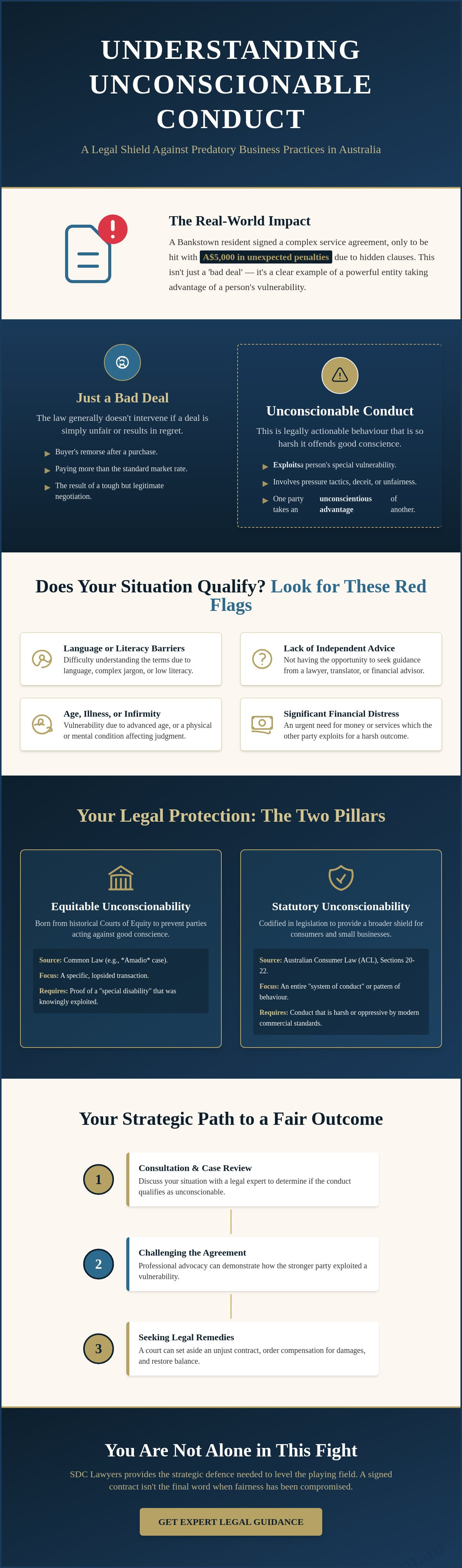
Identifying the Signs: Does Your Situation Qualify?
Recognising unconscionable conduct requires looking past the specific terms of a contract to the actual behaviour of the parties involved. It isn't just about a "bad deal." It's about a transaction so one-sided that it offends good conscience. In our experience as a Strategic Advocate for the Bankstown community, we see these patterns frequently when individuals are pushed into corners by larger entities. You might feel a sense of unease or regret, but you aren't always sure if it's illegal. We look for these specific indicators:
- A significant power imbalance where the business dictates every term.
- Pressure to sign documents on the spot without a cooling-off period.
- The use of complex legal jargon that wasn't explained to you.
- Terms that allow the business to change the price or service without your consent.
- Exploiting a person’s lack of education, age, or temporary financial distress.
The most common objection we hear is, "But I signed the contract!" You should know that a signature is not a death sentence for your legal rights. Australian law recognises that a signature obtained through exploitation or unfair pressure is not a true reflection of consent. If a business acted in a way that was harsh or oppressive, the court has the power to set that contract aside. You don't have to accept a predatory situation just because you put pen to paper during a moment of vulnerability.
This often overlaps with concepts like undue influence and duress. Duress involves direct threats or physical pressure. Undue influence is more subtle; it occurs when someone you trust, or someone in a position of power, uses that relationship to ensure you don't exercise independent judgement. These are the tools of the "hard-sell" culture we fight against every day.
Common Red Flags in Business Transactions
Many clients in Bankstown encounter "take-it-or-leave-it" contracts. These are often presented as standard forms where no negotiation is allowed. If a business used harassment or "boiler-room" pressure tactics to secure your signature, they may have crossed the line. We pay close attention to cases involving non-English speakers. If a company failed to provide a translator or didn't explain complex financial risks to a client who clearly didn't understand them, this is a major red flag. Since the Australian Consumer Law updates on 9 November 2023, the penalties for unfair practices have increased significantly, reflecting how serious these breaches are.
The Importance of Strategic Evidence
Proving unconscionable conduct requires more than just your word. It requires a methodical collection of evidence. We encourage you to keep every text, email, and handwritten note. Even a diary entry made immediately after a high-pressure meeting serves as vital circumstantial evidence. Some businesses try to protect themselves by insisting you sign a "certificate of independent advice." While this is a hurdle, it isn't an immunity shield for the business. If the advice you received was rushed or if the business still knowingly exploited your situation, we can still build a robust defence. We take a strategic approach to litigation, ensuring your journey toward justice is supported by a clear, evidentiary paper trail.
Local Advocacy: Protecting the Bankstown Community
Bankstown is one of the most culturally vibrant regions in Western Sydney, with 2021 Census data showing that over 60% of households speak a language other than English at home. While this diversity is a strength, it also creates specific vulnerabilities that predatory entities often target. SDC Lawyers acts as a strategic shield for this community. We understand that unconscionable conduct thrives in the gap between complex legal jargon and a client's right to understand what they're signing. Our firm prioritizes your emotional well-being and legal security by ensuring that no corporation takes advantage of a lack of familiarity with Australian regulations.
When a dispute arises, the path to justice usually begins in the NSW Civil and Administrative Tribunal (NCAT) or the Bankstown Local Court. For claims involving amounts under A$100,000, these local venues provide a more accessible route than the Supreme Court. We guide you through these local court processes with a methodical, calm approach. We handle the technical litigation so you can focus on rebuilding your life. Our team provides the stability you need when the balance of power feels unfairly tilted against you.
Language Barriers and Legal Exploitation
Australian courts recognize that a lack of English proficiency can constitute a "special disability." If a business knows you don't fully understand a contract but pushes you to sign anyway, they may be engaging in unconscionable conduct. We believe businesses in Bankstown have a proactive duty to ensure every customer understands their obligations. SDC Lawyers uses an empathetic, human-first approach to bridge this gap. We don't just translate words; we translate the legal implications to ensure you're never left in the dark. Our strategy is built on transparency and the belief that language should never be a barrier to justice.
Support for Bankstown Small Businesses
The Australian Consumer Law (ACL) doesn't just protect individuals; it provides a robust defence for small businesses with a turnover of less than A$10 million. Many local shop owners in Bankstown face unfair pressure during commercial lease renewals or supply agreement negotiations. Large landlords or national distributors sometimes use their superior bargaining power to impose "take it or leave it" terms that are clearly one-sided. This is where a strategic advocate becomes essential. We also see these patterns affecting the younger demographic in our area. If you're a student facing similar exploitation from predatory landlords, you should review our guide on Student Visa Australia: Strategic Legal Advice for Bankstown Students (2026) to understand your specific protections.
If you feel you've been pressured into an unfair agreement, don't wait for the situation to worsen. Contact SDC Lawyers today for a strategic assessment of your legal rights.
Seeking Justice: How SDC Lawyers Can Help
Identifying unconscionable conduct is the first step toward regaining control of your financial and emotional well-being. SDC Lawyers serves as a sophisticated legal defence for individuals in Bankstown who have been exploited by unfair commercial practices. We understand that the power imbalance in these situations can feel overwhelming. Our role is to act as a protective shield, positioning ourselves between you and the entities that have disregarded your rights.
We don't just look at the law; we look at the person behind the case. Our human-first approach ensures that your emotional well-being is prioritised alongside your legal success. This methodology allows us to build a robust case while providing the stability you need during a crisis. We offer a steady, calm influence that helps you move from a position of vulnerability to one of strength.
Strategic Remedies for Victims
The Australian legal system provides several avenues to rectify the harm caused by exploitative behaviour. Under the Australian Consumer Law, courts have the authority to declare a contract void from its inception. This means the agreement is treated as if it never existed, releasing you from unfair obligations. In other cases, the court may choose to vary the contract terms to remove the unconscionable elements.
Financial recovery is often a primary focus for our clients. We pursue various forms of compensation, including:
- Restitution: Returning money or property handed over under the unfair agreement.
- Compensatory Damages: Seeking A$ amounts to cover specific financial losses incurred due to the conduct.
- Injunctions: Court orders to stop the offending party from continuing their harmful actions.
Our ultimate objective is restoring balance. We work to ensure that the final outcome reflects a fair and just resolution for the hardships you've endured.
Your Journey to Resolution
Your path to justice begins at our Bankstown office. During your confidential consultation, we listen to your story with patience and empathy. We don't use cold, detached legalese. Instead, we explain the legal process in clear terms so you feel empowered rather than overwhelmed. In 2024, the ACCC reaffirmed that protecting vulnerable consumers from unconscionable conduct remains a top enforcement priority, and we leverage this regulatory environment to your advantage.
You aren't alone in this legal battle. We develop a strategic roadmap tailored to your specific circumstances, providing a clear way forward. Our firm has the stamina and the expertise to see your matter through to the end, whether that involves a negotiated settlement or rigorous litigation. We remain a dedicated ally from the first meeting until the final resolution is reached.
If you've been treated unfairly, it's time to take a stand. Contact SDC Lawyers today for strategic advice on your rights and begin your journey toward a fair outcome.
Secure Your Strategic Advantage in Bankstown
Navigating the complexities of unconscionable conduct requires more than just legal knowledge; it demands a tactical shield against exploitation. Whether you're facing unfair commercial terms or a lopsided family law dispute, the 2026 legal landscape in Western Sydney offers robust protections for those who act decisively. Identifying a special disadvantage is the first step toward restoring balance. Our team at SDC Lawyers serves as your strategic advocate, bridging the gap between cold statutory requirements and the human reality of your situation.
We bring deep expertise in both commercial and family law to the Bankstown community, ensuring no resident has to face large institutions or predatory practices alone. You deserve a partner who prioritizes your emotional well-being while aggressively defending your rights in the courtroom. We're here to provide the clarity and stability you need to move forward with confidence. Take the first step toward justice today by reaching out to a team that understands the heartbeat of Western Sydney.
Book a Strategic Consultation with SDC Lawyers in Bankstown
Your path to a fair resolution starts with a single, strategic conversation. We're ready to stand by your side.
Frequently Asked Questions
What is the most common example of unconscionable conduct?
The most frequent example involves a business taking advantage of a person's special disadvantage, such as a lack of English proficiency or a cognitive impairment. In many cases, this looks like a predatory lender forcing a high-interest loan on an elderly resident who doesn't understand the financial implications. The High Court of Australia established in the landmark 1983 case, Commercial Bank of Australia Ltd v Amadio, that acting against good conscience in these situations is illegal. It's about protecting the vulnerable from those who use their power as a weapon.
Can a small business sue a large corporation for unconscionable conduct?
Yes, small businesses receive specific protections under Section 21 of the Australian Consumer Law. This legislation prevents large corporations from using their overwhelming market power to impose harsh, one-sided terms that go beyond legitimate business interests. We often see this in retail tenancy disputes or franchise agreements where a large entity acts in bad faith. Our strategic approach ensures that even the smallest Bankstown business has a robust legal defence against corporate bullying.
Is unconscionable conduct the same as a breach of contract?
No, these are distinct legal concepts even though they often overlap in a single dispute. A breach of contract occurs when someone fails to follow the specific terms written in an agreement. Unconscionable conduct focuses on the harshness of the behavior and whether the transaction was fundamentally unfair or oppressive. You can have a contract that's technically valid but still legally void because the way it was formed was morally wrong.
How much does it cost to take an unconscionable conduct case to court?
Court costs vary depending on the complexity of the litigation and the chosen jurisdiction. For the 2024-2025 financial year, the Federal Court of Australia lists the standard filing fee for an individual at A$1,605. Beyond filing fees, you'll need to consider professional legal costs and expert witness fees. To ensure justice remains accessible, SDC Lawyers offers a No Win, No Fee commitment for eligible cases, which removes the financial barrier to starting your legal journey.
What happens if I signed a contract but didn’t understand it?
Signing a document doesn't automatically mean you're bound by it if you were at a significant disadvantage that the other party exploited. If a business knew you couldn't read the contract or didn't understand the technical language and they didn't suggest independent advice, the court may set the agreement aside. This protection is a core pillar of Australian equity law. It's designed to restore balance when one party is unfairly pressured into an agreement they don't comprehend.
Can unconscionable conduct apply to family law settlements?
Yes, the principles of unconscionability are frequently used to challenge unfair financial agreements under the Family Law Act 1975. If one partner used domestic violence, threats, or extreme emotional pressure to force the other into an unfair property split, the court can intervene. We provide a strategic shield for individuals in these high-stress situations. It's about ensuring that a settlement is reached through genuine consent rather than through the exploitation of a partner's trauma or fear.
What are the time limits for making an unconscionability claim in NSW?
You generally have 6 years from the date the conduct occurred to commence legal proceedings under the Australian Consumer Law. This timeframe is mirrored in the Limitation Act 1969 (NSW) for most civil claims. While 6 years sounds like a long time, evidence can fade and witnesses can move away. Acting quickly allows us to build the strongest possible case for your entitlements and ensures that your path to justice isn't blocked by unnecessary delays.
Does the ACCC help individuals with unconscionable conduct claims?
The Australian Competition and Consumer Commission (ACCC) investigates systemic issues but they don't usually act as a personal lawyer for individuals. They focus on cases that affect the broader Australian public or involve major breaches of the law. For a personal dispute in Bankstown, you'll likely need to pursue a private claim. We guide you through this process, providing the professional authority needed to challenge large entities while prioritizing your emotional well-being throughout the litigation.