

Imagine it's 2:00 AM on a Tuesday morning at Bankstown Police Station. Your loved one is behind bars, and the weight of the "Show Cause" requirement feels like an immovable wall between them and their home. You're likely feeling a paralyzing mix of anxiety and confusion as you face a legal system that often feels cold and indifferent. It's natural to worry that a single mistake or a misunderstood "Unacceptable Risk" test could lead to months of unnecessary remand while awaiting trial.
We understand that behind every person currently held in the NSW correctional system, there's a family waiting for answers. This guide provides a strategic, human-first roadmap to navigating bail applications in Bankstown. We'll show you exactly how to secure a release that prioritizes both legal success and your emotional well-being. We'll explore the 2026 legal standards under the Bail Act 2013, explain how to satisfy strict conditions, and show you why a local advocate is your strongest shield in the Bankstown Local Court.
Key Takeaways
- Understand how the NSW legal system upholds the presumption of innocence, defining bail as a vital conditional release that protects your fundamental rights.
- Navigate the complexities of the "Show Cause" and "Unacceptable Risk" tests to understand exactly how a Magistrate evaluates your eligibility for release.
- Learn how a custom "release package" can strengthen bail applications by strategically addressing the court’s concerns with specific conditions and sureties.
- Discover why a strategic advocate is essential for building a robust legal defense and avoiding the common pitfalls of self-representation.
- Find immediate, actionable steps for navigating the Bankstown Local Court Registry and contacting the custody manager at Bankstown Police Station.
What are Bail Applications in the NSW Legal System?
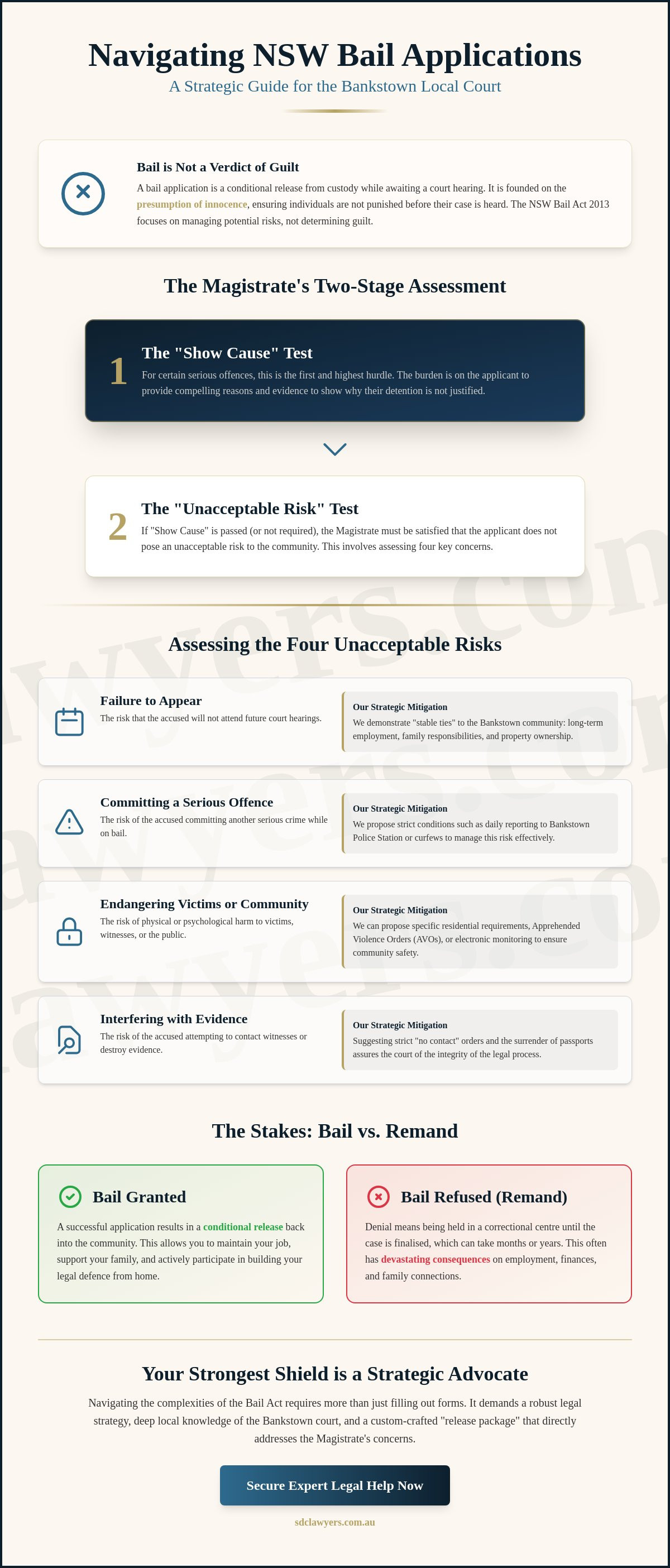
Entering the legal system can feel like being caught in a sudden storm. At its core, a bail application is your first step toward regaining control and stability. Bail isn't a verdict on your case; it's a conditional release from custody while you wait for your scheduled court hearing. This process is built on the fundamental Australian principle of the presumption of innocence. It ensures that you aren't punished with imprisonment before a magistrate has even heard the full evidence against you. Under the NSW Bail Act 2013, the law focuses on managing potential risks rather than determining guilt or innocence at this early stage.
It's vital to understand that bail applications are not pleas. You aren't admitting to a crime when you apply for bail. Instead, you're presenting a formal, Strategic legal argument. This argument demonstrates to the court that you can be safely released into the community under certain rules. These rules might include reporting to a police station, living at a specific address, or providing a financial security. In Bankstown, this process usually happens in two stages. First, the police at Bankstown Police Station decide whether to grant "police bail." If they refuse, the matter moves quickly to "court bail," where a magistrate makes the final decision.
The Role of the Bankstown Local Court
Most bail applications in our region begin at the Bankstown Local Court. The atmosphere here is often fast-paced and high-pressure. For family members attending, the sight of a loved one appearing via an audio-visual link from a cell can be deeply distressing. This is why having a Strategic advocate who understands the specific Bankstown registry is essential. Local legal representation knows the preferences of the sitting magistrates and the specific community resources available in the Canterbury-Bankstown area to support a successful release plan.
Bail vs. Remand: What is at Stake?
When bail is denied, the result is remand. This means staying in a correctional centre until the case is finalised, which can take months or even years. The impact is often devastating. You might lose your job, fall behind on mortgage payments, or suffer a total breakdown in family connections. Remand isn't just a legal status; it's a period of intense emotional and financial hardship that affects everyone in your circle. The "Show Cause" requirement represents the highest hurdle in NSW law, shifting the burden onto the applicant to justify why their detention isn't justified. We focus on providing the protective shield you need to overcome these hurdles and restore balance to your life.
Understanding the NSW Bail Act: Show Cause and Unacceptable Risk
The NSW Bail Act 2013 serves as the primary framework for all bail applications in the Bankstown Local Court. This legislation creates a structured process that balances your fundamental right to liberty with the safety of the public. When you appear before a Magistrate, the court isn't just looking at the facts of the alleged crime; it's performing a forward-looking assessment of risk. This assessment is divided into two distinct stages: the "Show Cause" test and the "Unacceptable Risk" test. Understanding how these tests interact is the first step in building a robust defence strategy that protects your future.
The Four Unacceptable Risks
If your offence doesn't require you to show cause, or if you've successfully shown cause, the Magistrate must then decide if you pose an unacceptable risk. In 2026, the court's scrutiny has intensified, particularly regarding digital footprints and community safety. The Magistrate evaluates four key concerns:
- Failure to appear: The court needs certainty that you'll attend future hearings. We mitigate this by presenting evidence of your "stable ties" to the Bankstown area, such as long-term employment, family responsibilities, or property ownership.
- Committing a serious offence: To address this, we often propose strict conditions like daily reporting to Bankstown Police Station or prohibited association orders.
- Endangering victims or the community: The court prioritizes the physical and psychological safety of others. We work to demonstrate that any perceived threat can be managed through residential stay requirements or electronic monitoring.
- Interfering with evidence: This involves the risk of contacting witnesses. By 2026, standards for evaluating this risk include your history of digital communication. We often suggest "no contact" orders and the surrender of passports to ensure the integrity of the legal process.
A successful application requires more than just a request for release. It involves a detailed plan that addresses these four risks head-on. When preparing these documents, referencing the Local Court bail procedures ensures that every procedural requirement is met with precision, giving the Magistrate the confidence they need to grant your freedom.
When the "Show Cause" Requirement Applies
For certain serious charges, the law presumes that you should remain in custody. In these "Show Cause" cases, the burden is on the accused to prove why their detention is not justified. This requirement typically applies to offences such as commercial drug supply, serious firearms charges, or crimes punishable by life imprisonment. It also frequently impacts matters involving Domestic Violence in Bankstown, where legislative amendments in recent years have made the path to bail significantly more challenging.
Proving "Show Cause" is a high legal hurdle. It requires a strategic focus on factors like the strength of the prosecution's case, potential delays in the court system, or personal circumstances such as a need for specialized medical treatment. If you find yourself facing a show cause offence, you need a strategic advocate who understands how to weave these complex factors into a compelling narrative for the court. We aim to act as a protective shield, ensuring that your rights are not overshadowed by the weight of the allegations against you.
Common Bail Conditions and the Role of a Surety
Securing your release through bail applications is rarely the end of the legal process. In most cases, the Bankstown Local Court grants bail subject to strict rules. These aren't intended to be a punishment. Instead, they serve a Strategic purpose by addressing specific concerns the Magistrate might have about your release. By 2026, the focus on risk mitigation in the NSW justice system has only intensified. If the court believes there's a risk you might not show up or could interfere with the investigation, they'll tailor conditions to neutralize those fears. Failing to follow these rules is a serious matter. A breach can lead to your immediate arrest and the potential loss of your freedom until your trial concludes.
Typical Conduct Requirements
Conduct requirements dictate your daily movements and help the court maintain supervision. You'll likely need to report to the Bankstown Police Station on North Terrace. The frequency depends on the perceived risk; some clients report daily, while others go once a week. Residency conditions are also standard. You must live at a verified address, and the court may impose a curfew, such as staying indoors from 8:00 PM to 6:00 AM. Additionally, non-association orders prevent you from communicating with co-accused parties or witnesses. These rules provide a protective shield for the community while allowing you to prepare your Defence from home.
What is a Surety or "Acceptable Person"?
An "acceptable person," or surety, is someone who vouches for your reliability. They provide a financial guarantee to the court. This means they either deposit a sum of money, often ranging from A$2,000 to A$20,000, or agree to pay it if you fail to appear. To be "acceptable" to a Bankstown Magistrate, this person should have a clean record and a stable background. They must prove they have the assets to cover the bond. This role carries a heavy burden. If you breach your bail, your surety risks losing their hard-earned savings. It's a Strategic partnership based on trust, designed to give the court peace of mind during your journey through the legal system. Common qualifications for an acceptable person include:
- Being over the age of 18.
- Having no current criminal proceedings or serious past convictions.
- Showing proof of identity and Australian residency.
- Demonstrating ownership of funds or property equivalent to the bail amount.
Choosing the right surety is a vital part of your legal strategy. It demonstrates to the court that you have a support network committed to your compliance. This collaborative approach helps restore balance and provides a clear path toward a positive resolution in your case.
The Strategic Advocate: Why Professional Legal Help Matters
Navigating the criminal justice system without a dedicated ally is a risk that carries heavy consequences. When your liberty is at stake, the preparation behind bail applications determines whether you return home or remain in custody. At SDC Lawyers, we act as a protective shield, ensuring your voice is heard and your rights are vigorously defended during these high-stakes moments. The complexity of bail applications in 2026 requires more than just a plea for mercy; it requires a tactical blueprint designed to address the court's specific concerns.
Avoiding the "One-Shot" Rule
The legal reality in New South Wales is strict. Under Section 18 of the Bail Act 2013, you generally only get one chance to argue for your release in the Local Court. If a Magistrate refuses your application, you can't simply ask again the following week. To secure a second hearing, you must prove there are "new facts or circumstances" that have emerged since the initial refusal. This is an incredibly high bar to clear. A rushed, amateur application often leads to a "one-shot" failure, leaving the accused in remand for months while awaiting trial. We ensure your first application is your strongest, leaving nothing to chance.
Crafting a Robust Release Plan
Our approach centers on building a "release package" that a Magistrate cannot reasonably ignore. We don't just make requests; we provide solutions to the court's concerns. This involves establishing a fixed address in Bankstown, identifying reliable character references, and proposing strict conditions that mitigate any perceived risks. Understanding where this fits in your legal timeline is essential. You can read our guide on what is a mention in court to understand how these strategic steps integrate into the broader journey toward justice.
A successful outcome relies on tangible evidence. SDC Lawyers meticulously gathers affidavits, employment confirmations, and rehabilitation placements to demonstrate your ties to the community. We also take a proactive stance by negotiating with the Police Prosecutor before the court session begins. By addressing their objections early and refining proposed conditions, we often reach an agreement that simplifies the Magistrate's decision. This level of strategic planning provides the stability and peace of mind you need during a crisis. We focus on the details so you can focus on your family.
If you or a loved one are facing a court appearance, don't leave your freedom to luck. Reach out to SDC Lawyers for a strategic defence of your rights and secure the professional advocacy you deserve.
Next Steps: Navigating the Bankstown Local Court Registry
The moments following an arrest are often the most volatile. If your loved one is currently in custody, the decisions you make in the next few hours will directly impact the success of future bail applications. You don't have to face the Bankstown Local Court Registry alone. Our role is to provide a protective shield, ensuring that the legal system treats your family with the dignity and fairness they deserve.
Your first priority is clear communication with the authorities. Contact the Bankstown Police Station at 156-158 Chapel Road and ask to speak with the custody manager. This officer is responsible for the well-being of those in the cells and can confirm if police bail has been refused. Once you have this confirmation, the matter will move to the Bankstown Local Court, usually on the next available sitting day. This is where our strategic preparation begins.
The First 24 Hours: A Checklist
- Locate the accused: Confirm they are being held at Bankstown Police Station or have been transferred to a remand centre.
- Secure a local solicitor: Engaging SDC Lawyers immediately allows us to review the police facts and prepare a robust argument before the first court appearance.
- Gather sureties: Identify family members or friends who can act as a "guarantor." You'll need their full names, current proof of address, and evidence of any equity or cash assets they can offer as security.
- Proof of residence: Prepare a formal letter or lease agreement confirming where the accused will live if they're released.
Booking Your Strategic Consultation
At SDC Lawyers, we don't believe in a one-size-fits-all approach to criminal defence. We provide tailored legal solutions that reflect the unique circumstances of your life. Our team prioritises integrity and ethical standards, ensuring that every piece of evidence we present is verified and compelling. We know that bail applications are about more than just legal paperwork; they're about restoring balance to your family and securing peace of mind.
We invite you to take a deeper dive into the mechanics of the legal system by reading our Strategic Guide to the Bail Application Process in Bankstown. This resource provides the clarity you need during a time of crisis. When you're ready to move forward, our strategic advocates are here to lead the way. We'll stand by you in the courtroom with the quiet confidence and resilience required to see your matter through to a successful conclusion.
Take the First Step Toward Your Freedom
Navigating the complexities of the Bail Act 2013 requires more than just legal knowledge; it demands a tactical approach tailored to the Bankstown Local Court. Success often hinges on addressing "show cause" requirements and mitigating "unacceptable risk" through precisely structured conditions. Whether you're coordinating a surety or preparing for a high-stakes hearing, the right preparation transforms a stressful ordeal into a manageable journey toward justice.
At SDC Lawyers, we don't just process paperwork. We act as your strategic advocate, providing a human-first defence from our office located in the heart of Bankstown. Our expertise in NSW Criminal Law ensures your bail applications are built on a foundation of professional authority and deep-seated empathy. We understand the high stakes of 2026 legal standards and work tirelessly to restore balance to your life during this difficult time.
Don't face the registry alone when your liberty is on the line. Secure your freedom with a Strategic Bail Application from SDC Lawyers Bankstown and gain the peace of mind you deserve. We're ready to stand as your protective shield and guide you through every stage of the legal process with quiet confidence.
Frequently Asked Questions about Bail Applications
What happens if bail is refused at Bankstown Local Court?
You'll remain in custody and be transported to a correctional facility if the magistrate refuses your release. Most individuals from Bankstown are moved to the Metropolitan Remand and Reception Centre (MRRC) while awaiting their next court appearance. This period is incredibly stressful, so we focus on a strategic review of the refusal to determine if a Supreme Court appeal is the best path for your defence. Our goal is to provide stability during this crisis.
Can I apply for bail again if my first application was denied?
You can apply again only if you demonstrate a "change in circumstances" under Section 74 of the Bail Act 2013. This might include new evidence, a change in your health, or a significant delay in the prosecution's case. It's vital to get the first application right, as subsequent attempts face a much higher legal threshold in the NSW court system. We help you identify the specific facts needed to justify a second hearing.
How much does it cost to make a bail application in NSW?
The NSW Government doesn't charge a filing fee for bail applications in the Local or District courts. You'll only need to cover the costs of your legal representation. While prices vary, private legal fees for these hearings in the Sydney region typically range from A$1,500 to A$4,500 depending on the complexity of the charges and the seniority of the lawyer representing you. This investment ensures you have a dedicated ally in the courtroom.
What is the "Show Cause" requirement in a bail application?
The "show cause" requirement means the accused must prove why their detention isn't justified before the court considers bail concerns. This applies to serious offences listed under Section 16B of the Bail Act 2013, such as certain drug trafficking or commercial robbery charges. If you can't show cause, the magistrate is legally required to refuse bail without further deliberation. It's a high hurdle that requires a methodical and prepared legal strategy.
Can a family member be a surety if they have a criminal record?
A criminal record doesn't automatically prevent a family member from being a surety, but the court will scrutinize their character. The registrar must decide if they're an "acceptable person" to provide a financial guarantee. If their record involves prior bail breaches or offences of dishonesty, the court will likely find them unsuitable to act as your protective shield. We assist families in presenting the strongest possible case for their suitability to the court.
How long does a bail hearing usually take in Bankstown?
Most bail applications at Bankstown Local Court are heard within 20 to 45 minutes. If your case involves complex "show cause" arguments or multiple police witnesses, the hearing can last over 90 minutes. We prepare every detail in advance to ensure the proceedings are steady and deliberate, providing the magistrate with a clear, strategic path toward granting your freedom. Our focus is on efficiency and clarity to minimize your time in custody.
Is bail guaranteed for minor driving offences?
Bail is never strictly guaranteed, but there's a "right to release" for most minor driving offences under Section 21 of the Bail Act 2013. This right exists unless you've previously failed to appear in court or have a history of violent behaviour. Even for minor matters, the police can still impose strict conditions like reporting to a station or surrendering your passport. We work to ensure these conditions don't unnecessarily disrupt your daily life.
What should I bring to court if I am acting as a surety?
You must bring 100 points of identification and evidence of your financial capacity to the court registry. This typically includes a current bank statement or a property rates notice showing available equity. Bringing these documents ensures the process moves quickly, helping your loved one secure their release and restoring balance to your family life during a difficult time. We guide you through every step to ensure your documentation meets the court's strict requirements.