

Last Tuesday at Bankstown Local Court, a young professional stood in the docks, his future hanging on a single decision while his family watched anxiously from the gallery. Like many Australians caught in the legal system, he was overwhelmed by the "show cause" requirement and the very real threat of being held in remand. It's a heavy burden to carry, especially when you know a single mistake or misunderstanding could lead to a permanent criminal record that jeopardizes your career or your visa status.
You likely feel that the law should be a shield, not a maze, and we agree that everyone deserves a fair chance to prepare their defence from the comfort of their own home. Our goal is to demystify the bail application process by offering a clear, strategic path toward your immediate release. We're here to ensure you can navigate the complexities of the NSW Bail Act with confidence and precision, turning a period of crisis into a manageable journey toward justice.
This guide provides a step by step breakdown of how to meet the court's strict criteria, negotiate sustainable bail conditions, and build a legal strategy that protects your liberty and your peace of mind.
Key Takeaways
- Understand the critical first steps at Bankstown Police Station and how initial decisions shape your journey toward securing a conditional release.
- Learn how to navigate the complex bail application process by effectively addressing the "Show Cause" and "Unacceptable Risk" tests mandated by the NSW Bail Act.
- Discover the essential steps for gathering respected community references and organising a financial surety to provide the court with the necessary stability for your release.
- Gain a clear understanding of the Bankstown Local Court environment and the specific roles each professional plays during your bail hearing.
- Recognise the value of a strategic advocate who acts as a protective shield, navigating bureaucratic hurdles to prioritise your emotional well-being and legal success.
Understanding the Bail Process After an Arrest in Bankstown
An arrest is a heavy burden that disrupts your life, family, and employment in an instant. At SDC Lawyers, we view the bail application process not just as a legal procedure, but as a critical mission to restore your freedom and peace of mind. In New South Wales, bail is defined as the conditional release of a person charged with an offence while they await their court hearing. This system is firmly rooted in the presumption of innocence, a cornerstone of Australian law that ensures you aren't punished before a magistrate has heard the facts of your case.
When an arrest occurs within the 2200 postcode, the Bankstown Police Station typically serves as the initial hub for legal decisions. The officers on duty have the authority to grant "police bail," allowing you to return home under specific conditions. If the police refuse this initial request, your case moves to "court bail," where a Magistrate at Bankstown Local Court makes the final determination. This distinction is vital; securing a release early in your legal journey prevents the trauma of unnecessary time in custody and allows you to prepare a strategic defence from the safety of your own home.
The legal framework governing these decisions is the NSW Bail Act 2013, which mandates a focus on potential risks to the community versus your fundamental right to liberty. Our role is to act as your protective shield, ensuring the court sees the person behind the charge rather than just a case number.
The First 24 Hours: From Arrest to Bail Hearing
The 24 hours following a formal charge are the most volatile. Once you're processed at the station, you'll be given the opportunity to contact a solicitor. You should exercise this right immediately. A strategic intervention at this stage can often influence the conditions set by police. If bail is refused at the station, the law requires the police to bring you before a Magistrate as soon as practicable, which usually happens the next business day at Bankstown Local Court. Fast action during these hours is the difference between sleeping in your own bed or remaining in a cell.
Types of Bail Decisions in NSW
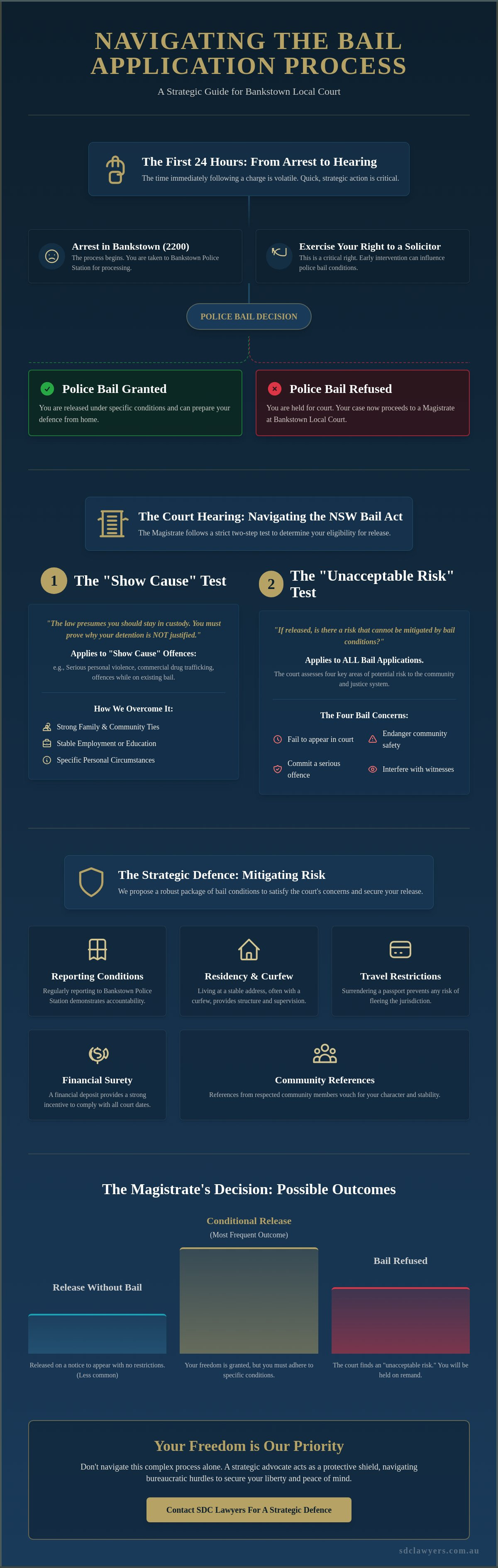
The outcome of a bail application process generally falls into three categories:
- Release without bail: This occurs when you're released on a notice to appear without any formal conditions or restrictions.
- Conditional release: This is the most frequent outcome for Bankstown residents. You may need to report to the Bankstown Police Station weekly, reside at a specific address, or surrender your passport.
- Bail refused: If a Magistrate identifies an "unacceptable risk" that cannot be mitigated by conditions, you'll be held on remand. We fight aggressively to prevent this outcome by proposing robust, strategic bail packages that satisfy the court's concerns.
Navigating the NSW Bail Act: Show Cause and Unacceptable Risk
The legal framework governing your freedom is found within the Bail Act 2013 No 26. Recent 2024 amendments and 2026 policy shifts have intensified the scrutiny placed on defendants at Bankstown Local Court. Every Magistrate follows a rigorous two-step test to decide if you can return home or if you must remain in custody. This bail application process isn't just a formality; it's a high-stakes assessment of your liberty and your future. Understanding your specific charge is the first step in building a Strategic Defence because it dictates which legal hurdles we must clear first.
The court's primary duty is to balance the fundamental rights of the accused with the safety of the Bankstown community. It's a delicate equilibrium. While the law maintains a presumption of innocence, the 2026 legal climate places a heavy emphasis on public protection. We work to tip the scales back in your favour by humanising your situation and providing a clear, structured path forward.
Overcoming the "Show Cause" Hurdle
If you're charged with a "show cause" offence, the law presumes you should stay in custody unless you prove your detention isn't justified. These charges often involve serious personal violence, commercial drug trafficking, or offences committed while already on bail or parole. To overcome this, we focus on your personal circumstances. In Bankstown, demonstrating strong family ties or stable employment at a local business can be a powerful mitigating factor. We don't just present facts; we tell your story to show the Magistrate that your release is the only just outcome. If you're feeling overwhelmed, a Strategic Defence consultation can help clarify your options.
Addressing the "Unacceptable Risk" Test
Once the "show cause" requirement is met, the court evaluates four primary risks. The Magistrate looks at the likelihood of you failing to appear in court, the risk of reoffending, the potential for interfering with witnesses, and any danger to the community. We mitigate these risks by proposing tailored conditions, such as:
- Daily reporting to the Bankstown Police Station.
- Strict residential stay requirements or curfews.
- Cash securities or "sureties" provided by family members.
- Prohibitions on contacting specific people or entering certain areas.
An unacceptable risk is the core barrier to freedom that exists when a Magistrate decides no combination of bail conditions can sufficiently protect the community or the integrity of the justice system. Our role is to ensure your bail application process includes a robust plan that addresses every concern the court might have. We provide the steady, professional guidance needed to navigate these complex bureaucratic systems and restore your peace of mind.
Step-by-Step: Preparing a Strong Bail Application for Court
A successful bail application process requires more than just a legal presence in the courtroom; it demands a meticulous assembly of evidence that demonstrates your reliability and ties to the community. At SDC Lawyers, we view this preparation as building a protective shield around your future. We start by gathering character references from respected members of the Bankstown community. These letters from local business owners, religious leaders, or long-term employers serve as a humanizing force. They provide the magistrate with a clear picture of your life outside the current charges, emphasizing your integrity and the support system waiting to help you succeed upon release.
Your journey toward restoring balance begins with a Strategic Bail Proposal. This document is the heart of your application. It directly addresses the specific concerns raised by the police, such as the risk of non-appearance or the potential for re-offending. By presenting a structured plan that includes employment details, medical appointments, or rehabilitation commitments, we show the court that your release is not just a request, but a managed transition back into society.
Identifying an Acceptable Person for Surety
A surety is a person who pledges a specific amount of money, such as A$5,000 or A$10,000, to the court as a guarantee that you will comply with your bail conditions. Under the NSW Bail Act 2013, the court must be satisfied that the surety is a "responsible person." This individual must be over 18 years of age, have no serious criminal record, and possess the financial means to cover the debt if the bail is breached.
It is vital to understand the difference between "lodging" money and "forfeiting" a debt. In many cases, the court may require the surety to deposit the cash immediately. In others, they may simply sign an agreement to pay if you fail to appear. We help your family navigate these financial complexities to ensure the surety understands their significant legal obligations.
Proposing Effective Bail Conditions
Strategic advocacy involves proposing conditions that satisfy the court's need for security while allowing you to maintain your daily life. Effective conditions often include:
- Reporting Requirements: Committing to check in at the Bankstown Police Station on Meredith Street at specified times.
- Residence Conditions: Providing a fixed Bankstown address where you will reside every night.
- Curfews: Agreeing to remain at home between 8:00 PM and 6:00 AM to mitigate risks.
- Non-Association: Pledging to avoid contact with specific individuals or locations related to the allegations.
For international residents, we also focus on the potential impact of criminal proceedings on your student visa or residency status. A criminal charge can trigger a Section 128 or Section 501 visa cancellation review. Our team coordinates your bail application with an eye toward these immigration consequences, ensuring your legal defence protects both your liberty and your right to remain in Australia.
What to Expect at Your Bankstown Local Court Bail Hearing
Stepping into Bankstown Local Court on Chapel Road often feels like a daunting milestone. The building remains a central pillar of the local justice system, characterized by a fast-paced environment and high-stakes decisions. Inside the courtroom, the atmosphere is strictly formal. You'll find the Magistrate at the elevated bench, flanked by court officers. To one side sits the Police Prosecutor, whose role is to highlight potential risks to the community. On the other side is your Defence Solicitor, acting as your voice and shield.
The bail application process isn't just a matter of filling out forms; it's a dynamic legal argument. Evidence is presented through a mix of written affidavits and oral advocacy. Your solicitor will highlight your ties to the Bankstown community to prove you aren't a flight risk. Most hearings are resolved quickly, often within an hour, with the Magistrate handing down a decision immediately after hearing both sides. This immediacy requires a solicitor who is sharp, prepared, and ready to pivot as the Prosecutor raises objections.
The Role of the Magistrate
Bankstown Magistrates apply the Bail Act 2013 (NSW) with a specific focus on the "unacceptable risk" test. They aren't just looking at the charges; they're looking at your character and your history. Respect is paramount in this setting. Addressing the court through a legal representative ensures your case is heard with the necessary gravitas. A Magistrate looks for a well-prepared bail affidavit that includes concrete details. This might include a confirmed residential address in Bankstown or letters from employers. These documents serve as the foundation of your strategic defence, proving that you have a stable environment to return to while awaiting trial.
What Happens if Bail is Granted or Refused
If the Magistrate grants bail, you must sign a bail acknowledgment. This is a binding contract with the court. It outlines strict obligations, such as daily reporting to the Bankstown Police Station or adhering to a curfew. For those with international ties, managing your partner visa requirements becomes a priority if the court imposes travel restrictions or passport surrender. We ensure these conditions are manageable before you leave the precinct.
If the court refuses bail, the situation is serious but not final. You'll be taken into custody, but we can immediately begin preparing for a "Bail Review." This often involves an application to the Supreme Court. Success in a review requires showing a change in circumstances or demonstrating that the initial decision was legally flawed. Our team remains by your side, providing the stamina needed for these complex secondary applications.
If you or a loved one are facing a hearing, you need a strategic legal defence to protect your freedom and future.
Why Strategic Legal Representation is Critical for Your Freedom
Attempting to navigate the bail application process alone is a gamble with your liberty. In the Bankstown Local Court, Magistrates expect precise legal arguments that directly address the "show cause" requirements and "unacceptable risk" criteria. Self-represented individuals often struggle to articulate these points under pressure, which frequently leads to avoidable remands. At SDC Lawyers, we act as a protective shield for our clients. We stand between you and the weight of the prosecution, ensuring your voice is heard without being overshadowed by complex legal jargon.
Our human-first approach prioritizes your emotional well-being during what is likely the most stressful period of your life. We understand that being in custody is a traumatic experience that ripples through your entire family. By securing your release, we restore balance to your life and give you the space to breathe. This isn't just about the immediate future; it's about the long-term success of your case. Data from the NSW Bureau of Crime Statistics and Research (BOCSAR) suggests that defendants who remain in the community while awaiting trial can more effectively assist in their own defence. A successful application is the first step toward a just final resolution.
The SDC Strategic Advantage in Bankstown
We bring deep cultural competency to every matter we handle. Our team understands the unique pressures facing the Bankstown community and the specific needs of the local veteran and Defence Force population. We craft rhythmic, clear legal arguments designed to resonate with the bench. By focusing on practical bail conditions, such as reporting requirements or residential stays, we provide the Court with a viable path to grant your freedom. Our goal is to replace your anxiety with a strategic roadmap for the journey ahead.
Contacting SDC Lawyers for Urgent Bail Support
If a loved one is currently in custody, time is the most valuable asset you have. You can book an immediate consultation with our team to begin the bail application process today. We maintain transparent hourly legal fees and adhere to the highest ethical standards, ensuring you know exactly where you stand financially and legally. We're here to provide the stability you need during this crisis. Secure your strategic advocate today and let us start fighting for your peace of mind.
Navigate Your Path to Freedom in Bankstown
Success in the Bankstown Local Court depends on a precise understanding of the NSW Bail Act 2013. You must effectively address show cause provisions and demonstrate that any potential risks can be managed through strict, strategic conditions. The bail application process is often the most critical hurdle in your legal journey, and the stakes for your personal liberty couldn't be higher. At SDC Lawyers, we combine specialised criminal law expertise with a human-first approach to ensure you feel supported and heard. We act as a protective shield between you and the complex court system, providing the steady guidance you need during this stressful time.
Our team focuses on restoring balance to your life by crafting a defence that prioritises both legal success and your emotional well-being. We understand the local Bankstown landscape and use this knowledge to advocate fiercely for your rights. Don't leave your future to chance when professional, empathetic support is available to lead the way. We're ready to provide the quiet confidence and tactical resilience your case deserves.
Secure your freedom with a Strategic Bail Advocate; contact SDC Lawyers now
Your journey toward justice starts with the right partner by your side.
Frequently Asked Questions
Can I apply for bail more than once in NSW?
You can only apply for bail more than once in a New South Wales Local Court if you demonstrate a change in circumstances or show that new facts have emerged since your first attempt. Under Section 74 of the Bail Act 2013, the court restricts multiple applications to prevent the waste of judicial resources. If your first application is unsuccessful, you might need to appeal to the Supreme Court or wait for a significant development in your case before reapplying.
What happens if I breach my bail conditions in Bankstown?
Breaching your bail conditions in Bankstown usually results in your immediate arrest and a return to custody. Police have the power to bring you before the Bankstown Local Court, where a magistrate will decide whether to revoke your bail entirely or allow you to remain at liberty with stricter conditions. According to the NSW Bureau of Crime Statistics and Research (BOCSAR), roughly 20 percent of individuals on bail face a breach report, which significantly complicates any future bail application process.
How much does it cost to get a lawyer for a bail application?
Legal fees for a private bail application in Sydney typically range from A$1,500 to A$4,500 depending on the complexity of the charges and the seniority of your solicitor. While we don't set a fixed price without a consultation, these figures reflect standard market rates for dedicated representation in 2026. If you're experiencing financial hardship, you may be eligible for assistance through Legal Aid NSW, which provides duty solicitors at Bankstown Local Court for those who meet their means test.
Is a surety always required for a successful bail application?
A surety is not a mandatory requirement for every successful bail application process, but it acts as a powerful strategic tool to reassure the magistrate. In many cases, the court may instead impose non-financial conditions like a daily police check-in or a residential requirement. However, if the court deems you a "show cause" or high-risk case, providing a financial security or a "bail guarantor" can be the deciding factor that secures your release from custody.
Can my bail conditions be changed after I am released?
You can apply to vary your bail conditions if your personal circumstances change, such as starting a new job or moving house. This requires filing a formal application with the court and notifying the police prosecutor at least 72 hours before the hearing. A magistrate will review the request and, if the police don't object and the risk remains low, they'll update your orders to better suit your current life situation.
How does a criminal charge affect my current Australian visa?
A criminal charge puts your Australian visa at significant risk under Section 501 of the Migration Act 1958. If you're sentenced to 12 months or more of imprisonment, your visa is subject to mandatory cancellation on character grounds. Even without a prison sentence, the Department of Home Affairs monitors all criminal proceedings, and a conviction can lead to a "Notice of Intention to Consider Cancellation," threatening your right to remain in the country.
What is the difference between bail and parole in NSW?
Bail is the temporary release of a person who has been charged with an offence but is still waiting for their court hearing or trial. It's based on the presumption of innocence. In contrast, parole is the conditional release of a prisoner who has already served the non-parole period of their sentence. While both involve supervision, bail focuses on ensuring you attend court, whereas parole focuses on your reintegration into the community after serving time.
What should I bring to my bail hearing at Bankstown Local Court?
You should bring your identification, written character references from employers or community members, and proof of your residential address, such as a utility bill. If a friend or family member is acting as a surety, they must bring their own ID and evidence of their financial assets, like a bank statement or property title. Having these documents organized shows the magistrate that you're prepared and take the legal proceedings seriously, which supports our strategic defence of your liberty.