

If you are the one initiating a claim in the Bankstown Local Court, you are no longer just a participant; you have become the most critical strategist in the room. Understanding the plaintiff meaning is the first step in moving from a state of hardship to a position of legal authority within the New South Wales justice system. We know that facing the courts often feels like walking through a fog of complex jargon and high-stakes pressure. You might feel the weight of the burden of proof or worry that a single procedural mistake could derail your path to justice.
This guide outlines your specific rights and the responsibilities you carry from the moment you file your statement of claim. You'll learn exactly how to start a claim and why your role is the anchor of the entire litigation process. We will explore how to transition from a place of uncertainty to one of quiet confidence by mastering the strategic steps required to restore balance to your life and secure your entitlements. By the end, you will have a clear roadmap for your legal journey in 2026 and the confidence to choose a partner who protects your future.
Key Takeaways
- Gain clarity on the plaintiff meaning within the New South Wales justice system as the party who initiates a civil claim to seek a remedy or financial compensation.
- Understand the dynamic between a plaintiff and a defendant to better prepare for your strategic role when navigating the Bankstown court system.
- Learn the essential steps for initiating a legal action, including why a well-crafted Letter of Demand is a critical first step in your litigation journey.
- Discover your fundamental rights to a fair hearing and your legal responsibility to mitigate losses to ensure the best possible outcome for your claim.
- See how a human-first legal strategy acts as a protective shield, prioritizing your emotional well-being and entitlements throughout the complex legal process.
Defining the Plaintiff Meaning in the Australian Legal System
In the Australian civil justice system, the plaintiff is the person or entity who starts the legal process. They feel a wrong has occurred and take the first step to seek a resolution through the courts by filing a formal complaint. Understanding the plaintiff meaning is the first step toward regaining control of your situation after an injury or loss. A plaintiff is the initiator of justice in civil proceedings.
It's vital to distinguish between a civil plaintiff and a criminal prosecutor to avoid common confusion. In a criminal case, a government prosecutor brings charges against an individual to seek punishment for a crime. In contrast, a plaintiff is a private party seeking a remedy for a civil wrong, such as medical negligence or a breach of contract. While the prosecutor seeks a conviction, the plaintiff seeks to restore balance to their life through a court-ordered resolution.
Terminology Variations: Plaintiff, Applicant, or Claimant?
In Australia, the name you're given depends on the specific court or tribunal handling your case. If you're filing a matter in the Federal Court or the New South Wales Civil and Administrative Tribunal (NCAT), you'll likely be referred to as an "Applicant." In personal injury or insurance cases, particularly those governed by the Motor Accident Injuries Act 2017, you might be called a "Claimant." SDC Lawyers helps you identify your correct standing in Bankstown legal filings. This ensures your paperwork is technically perfect from day one, providing a protective shield between you and complex bureaucratic systems.
The Core Objective of the Plaintiff
The primary goal of any plaintiff is to obtain a remedy that restores their position. This usually involves one of the following strategic paths:
- Damages: This is financial compensation designed to put you back in the position you were in before the harm occurred. For instance, in 2025, damages in a negligence case might cover A$50,000 in lost wages and ongoing medical costs.
- Injunctions: Sometimes, money isn't enough. A plaintiff may ask the court to stop a defendant from continuing a specific action that causes harm.
- Specific Performance: In contract disputes, a plaintiff might ask the court to force the other party to fulfill their original promise.
Strategic goal-setting is essential for every plaintiff before they enter the courtroom. We act as your strategic advocate to define exactly what success looks like for your specific journey. By identifying these objectives early, we create a clear path forward that prioritizes your emotional well-being and legal success. This methodical approach ensures you aren't just reacting to the system, but actively driving your case toward a fair conclusion.
Plaintiff vs. Defendant: Understanding the Courtroom Dynamic
In the legal landscape of Bankstown, every civil case begins with a clear division of roles. To grasp the plaintiff meaning, you must see them as the initiator of the legal journey. While the plaintiff is the party seeking a remedy for a perceived wrong, the defendant is the party required to respond to those allegations. This relationship isn't just a formal disagreement; it's a structured dynamic where a Strategic Advocate meets a Robust Defence.
We view this relationship as a balance between your personal needs and the legal obstacles ahead. The dynamic typically follows a specific trajectory:
- The Initiation: The plaintiff files the claim to seek justice or compensation.
- The Response: The defendant provides a legal rebuttal to the claims made.
- The Discovery: Both parties exchange evidence, which often reveals the true strength of each side's position.
- The Mediation: A neutral third party helps both sides reach a settlement before a trial becomes necessary.
As a case moves through the NSW court system, this dynamic shifts. Statistics from the NSW Department of Justice indicate that approximately 92 percent of civil matters resolve through settlement before reaching a final hearing. Understanding the defendant's likely response is critical for success. By anticipating their arguments early, we help you build a case that stands up to scrutiny. To start civil proceedings, a plaintiff must file a Statement of Claim, which sets the legal machinery in motion and establishes the grounds for the dispute.
The Burden of Proof: The Plaintiff's Primary Duty
In Australian civil law, the plaintiff carries the "burden of proof." Unlike criminal cases that require proof beyond a reasonable doubt, civil cases in Bankstown are decided on the balance of probabilities. This means you must prove your version of events is more likely than not. SDC Lawyers assists in gathering the necessary evidence, such as medical records and expert reports, to meet this legal threshold. We act as your shield, ensuring the weight of evidence stays firmly on your side while upholding our "No Win, No Fee" commitment to accessibility.
Counterclaims: When the Roles Blur
Sometimes, a defendant might file a counterclaim, effectively suing the plaintiff back within the same proceeding. These are often tactical moves in commercial disputes to complicate the narrative. Maintaining a steady, strategic focus is vital when the legal battle becomes complex. Our role is to ensure these tactical manoeuvres don't obscure the original negligence or injury. If you're feeling overwhelmed by the process, our supportive legal team is here to provide the stability and expertise you need to move forward.
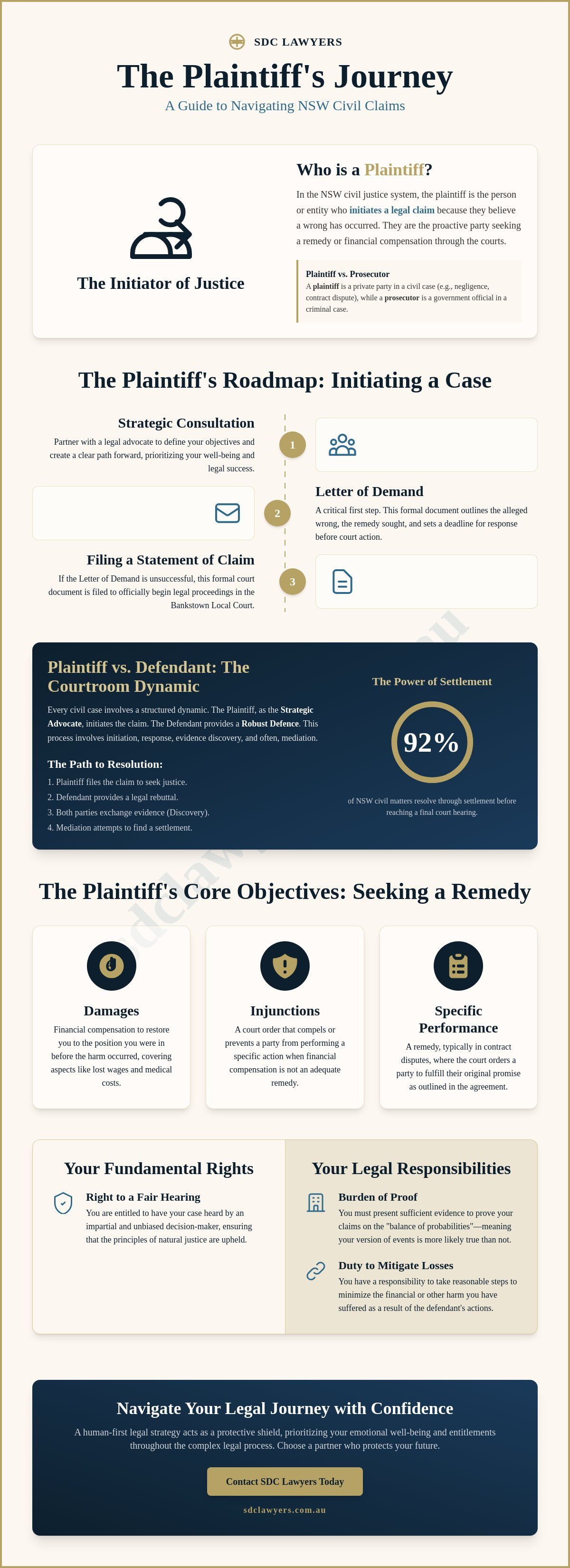
The Legal Journey: How a Plaintiff Initiates a Case in Bankstown
When you're dealing with the aftermath of an injury or a legal dispute, the path forward can feel overwhelming. Understanding the plaintiff meaning is the first step in reclaiming control of your situation. In the NSW legal system, the plaintiff is the person who brings a case against another in a court of law. In Bankstown, this journey begins with a strategic Letter of Demand. This formal notice gives the defendant a clear deadline to resolve the issue before court proceedings start. It's a vital tool that often leads to a resolution without ever stepping foot inside a courtroom.
If the Letter of Demand doesn't achieve a fair outcome, we move to formal litigation. This transition transforms your grievance into a structured legal battle where your rights are protected by the court's rules. Defining the plaintiff meaning in a practical sense means you're the one taking the initiative to seek justice. You aren't just a participant; you're the catalyst for accountability. Our role is to act as your shield, ensuring the process remains transparent and manageable while we pursue your entitlements.
Filing and Serving the Statement of Claim
To officially start your case, you must file a Statement of Claim. In Bankstown, this usually occurs at the Local Court on Chapel Road for matters up to A$100,000, or the District Court for larger claims up to A$750,000. This document must be precise, detailing the facts of your case and the specific relief you seek. Once filed, you must serve the defendant to ensure they're legally notified. Under the Limitation Act 1969, you generally have six years to start a claim for breach of contract, but personal injury timelines are much tighter, often limited to just three years. Missing these dates can end your claim before it begins.
The Discovery Phase and Evidence Gathering
The discovery phase is where strategic preparation turns into a position of strength. During this time, you'll exchange relevant documents with the defendant's legal team. It's a methodical process designed to prevent surprises at trial. We help you prepare detailed affidavits and witness statements that act as your voice, providing a clear narrative of the harm you've suffered. Data from the NSW Department of Communities and Justice indicates that a vast majority of civil cases settle before reaching a final hearing. A thorough discovery phase is often the reason why, as it reveals the undeniable strength of your position and encourages the other side to offer a favourable settlement.
Key Responsibilities and Rights of a Plaintiff in NSW
Grasping the plaintiff meaning goes beyond knowing who starts a lawsuit; it's about understanding the weight of the role. As a plaintiff in New South Wales, you're entitled to a fair hearing and the right to choose your own legal representation. These rights ensure you aren't alone when facing powerful entities. However, the legal system also places specific duties on you. One critical responsibility is the duty to mitigate losses. You can't claim compensation for financial or physical harm that you could've reasonably avoided through sensible action after the event. You also owe the court "full and frank disclosure," meaning you must be honest and transparent throughout the discovery process. While your legal team provides the strategy, you hold the ultimate authority. You always have the final say on whether to accept or reject a settlement offer.
Costs and Financial Considerations
The financial side of litigation involves two main categories: "party-party" costs and "solicitor-client" costs. Under the Legal Profession Uniform Law, the court usually orders the losing party to pay a portion of the winner's legal fees, known as party-party costs. This rarely covers the entire bill, usually reaching about 60% to 75% of the total. The remaining balance is the solicitor-client cost. SDC Lawyers utilizes strategic fee structures to ensure our services remain accessible to the Bankstown community. We view our "No Win, No Fee" commitment as a moral obligation to provide a robust legal defence for those who might otherwise be silenced by the cost of justice.
Mediation and Alternative Dispute Resolution (ADR)
Most legal journeys don't end in a dramatic courtroom trial. In fact, data from the NSW civil court system suggests that over 90% of claims settle through mediation or ADR before a final judgment is reached. This process is often faster and much less stressful than a public hearing. It provides a private space where a strategic advocate can negotiate terms that truly reflect your needs. Mediation gives you the power to reach a resolution that a judge might not be able to grant, such as a formal apology or specific service agreements. We focus on achieving these outcomes early to protect your emotional well-being and get your life back on track sooner.
Strategic Advocacy: Why Bankstown Plaintiffs Trust SDC Lawyers
Choosing to initiate legal action is a significant life decision. At SDC Lawyers, we recognise that behind every case is a human story that deserves to be heard. We act as a protective shield for our clients, standing firm against complex bureaucratic systems, large corporations, and aggressive insurance firms. Our human-first approach ensures that while we pursue the best possible results, your mental and emotional well-being remains our top priority. We understand the plaintiff meaning goes beyond a simple legal definition; it represents a person seeking to correct a wrong and restore their peace of mind.
Our presence in the Bankstown community is built on years of local engagement. We have deep-rooted knowledge of the local legal landscape, including the specific procedural expectations of the Bankstown Local Court. This local fluency allows us to bypass hurdles that might delay firms from outside the area. We combine this insight with a commitment to the highest standards of professionalism and ethical practice. You aren't just hiring a solicitor; you're gaining a dedicated advocate who understands the heartbeat of the South West Sydney community.
Tailored Legal Solutions for Every Hardship
Whether you're dealing with a commercial dispute or a sensitive family matter, we offer a calculated path forward. For couples navigating the complexities of immigration law, we provide specialised support for a partner visa australia, ensuring every detail of your application is sound. Our "Strategic" anchor is more than just a name. It's our promise that every legal maneuver is designed for maximum impact and long-term stability. We focus on outcomes that protect your future, not just your present. This methodical approach ensures that the plaintiff meaning in your specific case is translated into tangible justice.
Your Journey Starts with a Consultation
We strive to make the entry into the legal system as seamless as possible. Our consultations are designed to be a safe space where you can share your story without judgment. To help us hit the ground running, please bring any evidence related to your case, such as:
- Relevant correspondence or emails from the opposing party.
- Medical reports or certificates if your claim involves injury.
- Contracts, agreements, or financial records.
- A brief timeline of events leading to the dispute.
This information allows us to provide an honest assessment of your entitlements and the strength of your position. We believe in transparency and will always give you a realistic view of the journey ahead. We don't use confusing legalese to hide the facts. Instead, we provide clear, direct advice that empowers you to make informed decisions. Book your consultation today and let us help you restore balance to your life.
Take the Next Step in Your Legal Journey
Navigating the NSW legal system requires more than just knowing the plaintiff meaning; it demands a clear understanding of your rights within the District and Local Courts. You've learned that being a plaintiff involves a commitment to the truth and a rigorous adherence to procedural timelines. Whether you're seeking justice for medical negligence or a service injury, the path from filing a statement of claim to reaching a final settlement is often complex. In 2026, the Bankstown legal landscape continues to evolve, making it vital to have a partner who understands local court dynamics and the emotional weight of your case. Our team at SDC Lawyers combines deep expertise in NSW court procedures with a human-first approach that prioritizes your peace of mind.
We're strategically aggressive in litigation but remain patient and supportive during every consultation. We act as your protective shield, ensuring that bureaucratic hurdles don't stand in the way of your entitlements. You deserve an advocate who values your story as much as the legal result. Secure your strategic legal advantage as a plaintiff; book a consultation with SDC Lawyers today. We're here to help you restore balance to your life and move forward with confidence.
Frequently Asked Questions
What is the simplest meaning of a plaintiff?
A plaintiff is the person or entity who starts a legal claim against another party in a civil court. When you're learning about the plaintiff meaning, it's helpful to see them as the party seeking a remedy for a perceived wrong. At SDC Lawyers, we act as a strategic shield for plaintiffs, ensuring their voice remains clear and powerful throughout the entire litigation process.
Can a company be a plaintiff in an Australian court?
Yes, a registered company is recognized as a legal person in Australia and can initiate proceedings as a plaintiff. Under the Corporations Act 2001, businesses have the right to sue for issues like breach of contract or debt recovery. This allows organizations to protect their commercial interests and seek justice just as an individual would during their legal journey.
What happens if a plaintiff loses their case in NSW?
If a plaintiff loses their case in NSW, the court usually orders them to pay a portion of the defendant's legal costs. This principle is known as the "costs follow the event" rule under the Civil Procedure Act 2005. While this creates a financial risk, our strategic planning focuses on minimizing these hazards and providing a clear path forward before you ever enter a courtroom.
Is it better to be the plaintiff or the defendant in a lawsuit?
Neither role is inherently better, but the plaintiff holds the strategic advantage of choosing when and where to start the legal action. As the plaintiff, you define the scope of the allegations and the specific compensation you're seeking. However, you also carry the burden of proof, which means you must provide enough evidence to convince the court of your claim's validity.
How much does it cost to start a case as a plaintiff in Bankstown?
Filing fees in the Bankstown Local Court depend on the value of your claim, with an individual filing a small claim under A$20,000 currently paying A$112 as of July 2023. For claims between A$20,000 and A$100,000, the standard filing fee for an individual increases to A$276. These government charges are a necessary first step in accessing the justice system and restoring balance to your life.
Can a plaintiff withdraw their case after it has started?
A plaintiff can withdraw their case by filing a Notice of Discontinuance, but they'll usually be responsible for the defendant's legal costs up to that point. It's often necessary to get the defendant's consent or the court's permission to end the proceedings early. We provide transparent and honest advice to ensure you don't face unexpected financial burdens if your situation or goals change during the process.
How long does a plaintiff have to wait for a court date in Bankstown?
Plaintiffs in Bankstown typically wait between 6 and 9 months for a final hearing date after their initial filing. The NSW Local Court Annual Review indicates that the court system aims to finalize 90% of civil matters within a 12 month period. This timeline shows why having a strategic advocate is vital to keep your case moving forward without unnecessary delays.
What is the difference between a plaintiff and a complainant?
The main difference is the type of court involved, as a plaintiff initiates civil litigation while a complainant is a witness in a criminal prosecution. In civil matters, the plaintiff meaning relates to a person seeking a private remedy like financial compensation for negligence. In criminal cases, the police prosecute the matter on behalf of the Crown, and the complainant is the individual who reported the crime.