

Imagine waking up on a Tuesday morning in Bankstown to a letter stating your right to drive is suspended for 90 days. For many locals, this isn't just a minor inconvenience; it's a direct threat to their employment and family stability. You likely understand that a single mistake on the road can lead to complex driving offences that carry heavy penalties under NSW law. It's natural to feel overwhelmed by the intricate demerit point system or the looming stress of an appearance at Bankstown Local Court.
We believe that one error shouldn't cost you your livelihood. This guide provides the strategic advice you need to protect your driving privileges and restore your peace of mind as we move into 2026. You'll discover how to challenge unfair fines, manage your demerit points effectively, and present a robust defence to avoid a criminal record for serious matters. We'll explore the specific legal pathways available to keep you on the road and support your family's future.
Key Takeaways
- Understand how the unique traffic landscape of Bankstown and the M5 corridor shapes the enforcement of various driving offences under current NSW law.
- Learn the specific demerit point thresholds for 2026 to help you proactively manage your licence status and prevent unexpected suspensions.
- Identify the strategic differences between minor infringements and major criminal charges to better assess the potential impact on your long-term record.
- Discover the essential steps for challenging a penalty notice, including how to effectively request an internal review through Revenue NSW.
- Explore how a "human-first" legal approach can safeguard your future, particularly for those concerned about the impact of traffic matters on a student visa or residency status.
Understanding Driving Offences in Bankstown: A Local Guide to NSW Traffic Law
Receiving a penalty notice in the mail or being pulled over on the Hume Highway creates an immediate sense of instability. In New South Wales, a driving offence is defined as a breach of the Road Rules 2014. These breaches encompass a broad spectrum of conduct, ranging from minor administrative infringements to serious criminal charges that carry the risk of imprisonment. For residents in Western Sydney, the stakes are particularly high because our infrastructure demands constant mobility.
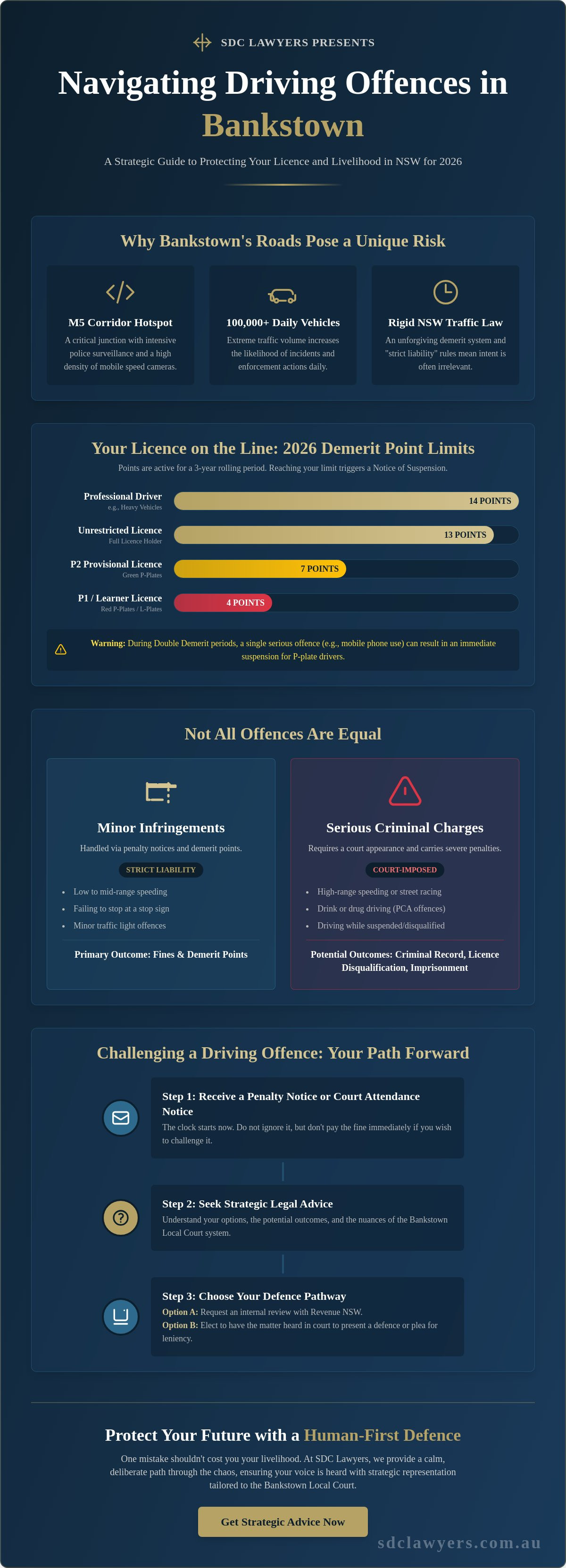
Bankstown serves as a critical junction for the M5 corridor, a stretch of motorway that sees upwards of 100,000 vehicle movements on a daily basis. This high traffic density results in intensive police surveillance and a sophisticated network of mobile speed cameras. Unlike other Australian states, NSW traffic law is notoriously rigid. The demerit point system is unforgiving, and certain driving offences trigger immediate roadside licence suspensions that can't be stayed without a specific court appeal. The financial impact is often immediate, with some mid-range speeding fines exceeding A$500, yet the emotional toll of losing your independence is frequently the heavier burden.
The Reality of Traffic Charges in New South Wales
Most driving offences in our state are classified as 'strict liability' matters. This means the police don't need to prove you intended to speed or fail to stop; they only need to prove the act occurred. The NSW Police Force coordinates closely with Transport for NSW (TfNSW) to ensure enforcement is seamless. These state-specific regulations are built upon the foundational framework of the Australian Road Rules, which standardises road safety across the country. We see many clients who feel overwhelmed by the speed of the system, where a single camera flash leads to a complex legal battle within days.
Why Local Bankstown Representation Matters
The Bankstown Local Court, situated on the corner of Chapel Road and The Mall, handles a significant volume of traffic disputes every week. Every magistrate has a distinct style and specific expectations regarding how evidence is presented. SDC Lawyers acts as a protective shield for the local community by providing a strategic defence tailored to these local nuances. We understand the specific prosecutorial styles of the local police units and how to present your personal circumstances effectively. Our role is to provide a calm, deliberate path through the chaos, ensuring your voice is heard in a system that often feels automated and cold. We focus on restoring balance to your life while protecting your right to remain on the road.
Demerit Points and Licence Suspensions: How the NSW System Impacts You
In NSW, the demerit point system isn't just a tally; it’s a regulatory mechanism designed to monitor driver behaviour and encourage safety. Points are recorded on your driving record when you pay a penalty notice or are convicted of certain driving offences by a court. Most points remain active for a three-year window. Transport for NSW looks at a rolling three-year period when determining if you’ve reached a limit. It’s vital to remember that while the points "expire" for suspension purposes after three years, the history of the offence stays on your permanent driving record indefinitely.
Understanding Demerit Point Thresholds
Your licence type dictates your margin for error. In 2026, the thresholds remain strict to ensure road safety in high-traffic corridors across Bankstown. Unrestricted licence holders have a 13-point limit. Professional drivers, such as heavy vehicle operators, are granted a 14-point buffer. For those early in their driving journey, the stakes are significantly higher. P2 drivers face a suspension at 7 points, and P1 or Learner drivers have only a 4-point limit. During double demerit periods, such as the 4-day Easter long weekend or the Christmas-New Year break, a single mobile phone or speeding offence can result in an immediate breach of these thresholds. When you hit the limit, you'll receive a Notice of Suspension, which typically gives you 28 days before you're legally barred from the road.
Suspension vs. Disqualification: Protecting Your Freedom
While many people use these terms interchangeably, the legal distinction is vital for your defence strategy. A suspension is an administrative action taken by Transport for NSW. It often follows a point limit breach or specific high-range speeding. In contrast, a disqualification is a mandatory legal penalty imposed by a Magistrate in a local court. This usually occurs following serious driving offences like drink driving or negligent driving.
Losing your licence creates a massive rift in your daily life. It affects your ability to reach work in Bankstown, manage family commitments, and maintain your independence. The strategic implications are different for each. A suspension for an unrestricted driver might allow for a "Good Behaviour Election," whereas a court-ordered disqualification offers no such choice. Our team at SDC Lawyers acts as a strategic advocate to help you explore options like a court appeal to restore balance to your life and protect your livelihood. We understand that a mistake behind the wheel shouldn't cost you your career.
Categorising Traffic Offences: From Speeding Fines to Serious Criminal Charges
In Bankstown, the distinction between a simple fine and a criminal record often rests on the specific nature of the driving offences committed. While a momentary lapse in concentration might lead to a demerit point deduction, more serious violations can result in immediate licence suspension or even imprisonment. We understand that a mistake behind the wheel doesn't define your character, but it does require a strategic response to protect your future.
Common Traffic Infringements and Fines
Speeding remains the most frequent infringement in the Canterbury-Bankstown region. Penalties scale sharply from exceeding the limit by less than 10km/h to high-range speeding over 45km/h. In 2026, AI-integrated camera systems across the Bankstown local government area have significantly increased detection rates for mobile phone and seatbelt violations. School zones, particularly around busy corridors like Chapel Road and Canterbury Road, carry heavy financial penalties and double demerits during peak periods. Understanding the NSW demerit points system is vital for anyone relying on their licence for work, as reaching your limit triggers an automatic suspension notice from Transport for NSW.
Serious Offences: Drink, Drug, and Dangerous Driving
Alcohol and drug-related charges carry a different weight. NSW law categorises Prescribed Concentration of Alcohol (PCA) into low, mid, and high ranges. A high-range PCA, which is a reading of 0.150 or higher, carries a mandatory interlock order. We view the interlock program as a strategic tool to help clients maintain some mobility while demonstrating rehabilitation to the court. The most severe driving offences involve dangerous driving occasioning death or grievous bodily harm. These are strictly indictable matters where the stakes involve long-term custodial sentences and a permanent criminal record. Our role is to act as a protective shield, ensuring your side of the story is heard with clarity and professional authority.
For many in our diverse Bankstown community, a criminal conviction for a traffic matter creates a direct conflict with immigration law. A conviction can trigger a failure of the "character test" under Section 501 of the Migration Act. This risks visa cancellation or the denial of citizenship applications. Beyond Australia, a criminal record can complicate travel to countries like the United States or Canada, where strict entry requirements often exclude those with serious traffic convictions. Protecting your licence is about more than just keeping your car; it's about safeguarding your global freedom and your place in the Australian community.
Challenging a Driving Offence: Strategic Options for Bankstown Residents
Receiving a penalty notice can feel like a sudden weight on your shoulders, especially when your livelihood depends on your ability to drive. In Bankstown, where many residents rely on their vehicles to reach worksites or transport family, the impact of driving offences extends far beyond a simple fine. We believe in a methodical, human-first approach to protecting your record and your peace of mind.
The path to defending your licence involves five critical steps. First, we assess the validity of the evidence, such as checking the calibration records of speed cameras or reviewing police bodycam footage for procedural errors. Second, we may request an internal review through Revenue NSW. This is a vital step if there is a clear factual error, such as an incorrect number plate or a medical emergency. Third, you have the option to elect to have the matter heard in the Bankstown Local Court. This moves the case from an administrative system to a judicial one where your voice can be heard. Fourth, we often prepare a 'Section 10' dismissal strategy. This provision under the Crimes (Sentencing Procedure) Act 1999 allows a Magistrate to find you guilty but dismiss the charge without recording a conviction or a fine. Finally, we present your subjective circumstances, such as your need for a licence to care for dependents or maintain employment, to the Magistrate.
Reviewing Your Penalty Notice
An internal review is appropriate when you can prove a mistake was made or if there are exceptional circumstances. However, Revenue NSW maintains strict guidelines for leniency. It's often difficult to secure a withdrawal for high-speed offences over 20km/h or safety-critical incidents in school zones. You must respond to your notice within the 28-day window to avoid additional late fees or immediate enforcement action.
Navigating the Court Process Strategically
There are distinct benefits to pleading guilty with an explanation rather than attempting a complex defence without merit. By acknowledging the mistake and showing genuine remorse, we can focus on mitigation. We help you build a robust case by gathering professional character references and encouraging the completion of the Traffic Offenders Rehabilitation Program (TORP). These proactive steps demonstrate to the Bankstown Magistrates that you are committed to road safety. SDC Lawyers provides strategic advocacy by acting as your protective shield in the courtroom. We ensure your personal history and the hardships you face are presented with clarity and impact. Our goal is to restore balance to your life while navigating these complex bureaucratic systems.
If you are worried about losing your licence, reach out to SDC Lawyers for a strategic legal defence tailored to your specific situation.
Strategic Legal Defence: Why SDC Lawyers is Your Best Ally
Facing a charge for driving offences in Bankstown is more than a legal hurdle. It's a significant disruption to your life's stability. At SDC Lawyers, we don't treat you as a case number. We adopt a human-first approach to criminal and traffic law. This means we prioritize your emotional well-being while building a robust legal shield around your interests. Our team understands the stress of a court date. We act as a protective barrier between you and the complex judicial system.
For many in our local community, a conviction carries risks that extend far beyond a fine. It can directly jeopardize your student visa or permanent residency status. Under the Migration Act 1958, certain convictions may trigger a character test review. We strategically manage your matter to minimize these impacts, aiming for outcomes that protect your future in Australia.
The SDC commitment is built on two pillars: clear communication and financial certainty. You'll never be left wondering about the status of your case. We offer transparent fixed-fee options for most traffic matters. This ensures you can budget for your legal costs without the fear of hidden expenses. Our goal is to restore balance to your life after a traumatic legal encounter, providing a clear path toward resolution.
Compassionate Support for Complex Cases
Families and individuals in Bankstown often face multifaceted challenges when dealing with the law. We provide tailored legal solutions that look at the root causes of an incident. If underlying issues contributed to the situation, we guide you toward accredited traffic offender intervention programs. These programs are vital. They demonstrate a genuine commitment to rehabilitation to the Magistrate, which can be a decisive factor in sentencing. Professional representation offers the peace of mind you need to move forward with confidence.
Securing Your Livelihood Through Expert Advocacy
Your right to drive is often tied to your survival. Whether you're commuting to a job, attending university, or managing family responsibilities, a licence disqualification can be devastating. Our advocacy focuses on protecting your mobility. We maintain the highest ethical standards while fighting for your right to remain on the road. We believe in strategic planning and tactical precision in the courtroom. We stand as your dedicated ally, ensuring your voice is heard and your rights are defended with integrity.
Take the first step toward protecting your future.
Secure Your Future on the Road
Facing the NSW legal system alone is overwhelming. The 2026 demerit point landscape is stricter than ever, and the consequences of driving offences extend far beyond a simple fine. We've seen how these matters impact families and careers across the Bankstown community. Our team specialises in the Bankstown Local Court, offering a unique blend of criminal law expertise and integrated immigration insights. This dual focus is vital if your residency status is tied to your legal standing. We pride ourselves on a human-first approach, acting as your strategic advocate to navigate bureaucratic hurdles with quiet confidence. You don't have to carry this burden by yourself. We're here to provide the stability and robust legal defence you need to move forward. Every case we handle is built on a foundation of empathy and tactical precision. We understand that your licence represents your freedom and your ability to provide. Let us help you protect it.
Secure a Strategic Consultation with SDC Lawyers Today
Take the first step toward restoring your peace of mind and securing your path forward.
Frequently Asked Questions
Can I appeal a licence suspension in NSW if I need my car for work?
You can lodge an appeal with the Local Court within 28 days of receiving a suspension notice from Transport for NSW. To succeed, you must demonstrate to the Magistrate that you're a fit and proper person and that losing your licence would cause exceptional hardship. Data from the Bureau of Crime Statistics and Research indicates that successful appeals often rely on a strategic presentation of your professional and personal circumstances.
What happens if I ignore a driving offence penalty notice?
Ignoring a penalty notice triggers an enforcement order from Revenue NSW, which adds an immediate A$65 late fee to your debt. If the fine remains unpaid, the state can suspend your driver's licence or cancel your vehicle registration under the Fines Act 1996. Eventually, authorities may garnish your wages or seize property to satisfy the debt, turning a simple matter into a complex legal crisis.
How long does a drink driving charge stay on my criminal record in NSW?
A drink driving conviction remains on your permanent criminal record indefinitely, though it becomes a spent conviction after 10 years of crime-free behavior under the Criminal Records Act 1991. While it might not appear on standard employment checks after a decade, it stays on your traffic history for life. This permanent record can influence the severity of penalties for any future driving offences you might face.
Is it possible to avoid demerit points by going to court?
You'll only avoid demerit points if the Magistrate grants a Section 10 dismissal or a Conditional Release Order without conviction. If a conviction is recorded, Transport for NSW is legally bound to apply the points regardless of the court's sentiment. Our strategic defence focuses on highlighting your good character to help the court lean toward a non-conviction, protecting your mobility and peace of mind.
What is a Section 10 dismissal and how do I get one in Bankstown?
A Section 10 dismissal means the court finds you guilty but chooses not to record a conviction, which saves your licence and keeps your record clean. To secure this outcome at Bankstown Local Court, you must provide compelling evidence of your character and the specific hardships a conviction would cause. It's a rhythmic process of acknowledging the mistake while proving that a formal penalty is unnecessary for your rehabilitation.
Can a driving offence affect my Australian citizenship or visa application?
Serious traffic violations can impact the "good character" requirement for visa and citizenship applications under Section 501 of the Migration Act 1958. While a single minor fine is rarely an issue, multiple driving offences or a significant conviction can lead to visa delays or even cancellations. The Department of Home Affairs reviews your entire history to ensure you respect the laws of the Australian community.
How much does it cost to hire a traffic lawyer in Bankstown?
Legal fees for traffic matters in the Bankstown area typically range from A$1,500 to A$3,500 for a standard guilty plea and sentencing hearing. More complex litigation involving defended hearings will incur higher costs based on the time required for your defence. We view our fee structure as a moral promise of accessibility, ensuring you have a dedicated advocate to guide you through the legal wilderness.
What should I do if I am pulled over for a random breath test (RBT)?
You're required by the Road Transport Act 2013 to stop immediately and provide a breath sample when directed by a police officer. Stay calm and provide your name and licence, as being cooperative can help manage the stress of the situation. Don't refuse the test; the law treats a refusal with the same severity as high-range drink driving, which carries mandatory licence disqualification and potential imprisonment.