

A single missing document in your partners visa application isn't just a clerical error; it's a potential barrier between you and the person you love most. In Bankstown, where diverse families form the heart of our community, the fear of a visa rejection leading to forced separation is a heavy burden to carry. You've likely spent late nights staring at the Department of Home Affairs portal, feeling overwhelmed by the sheer volume of evidence required to prove your life together is genuine. It's exhausting to face changing 2026 regulations when your future hangs in the balance.
We believe your relationship deserves a robust defence against bureaucratic complexity. That's why we've developed a strategic checklist designed to give you total peace of mind and a clear roadmap to success. You'll learn exactly how to organize your financial, social, and household evidence to meet the highest standards of the law. This guide provides a step by step breakdown of the 2026 requirements, ensuring your journey toward permanent residency is handled with the precision and care it deserves.
Key Takeaways
- Understand the two-stage journey from temporary to permanent residency and how the 2026 regulatory landscape specifically impacts couples in Western Sydney.
- Master the "4 Pillars" of a genuine relationship with a strategic checklist for gathering the financial and social evidence required by the Department.
- Evaluate the strategic benefits of onshore versus offshore applications, including a clear breakdown of bridging visa entitlements for those residing in Bankstown.
- Streamline your local logistics with a guide to finding Justices of the Peace in Bankstown to ensure your partners visa documentation is certified correctly and efficiently.
- Discover how strategic legal advocacy acts as a protective shield, helping you navigate complex bureaucratic hurdles and avoid the long-term impact of a visa refusal.
Navigating the Australian Partner Visa Landscape from Bankstown
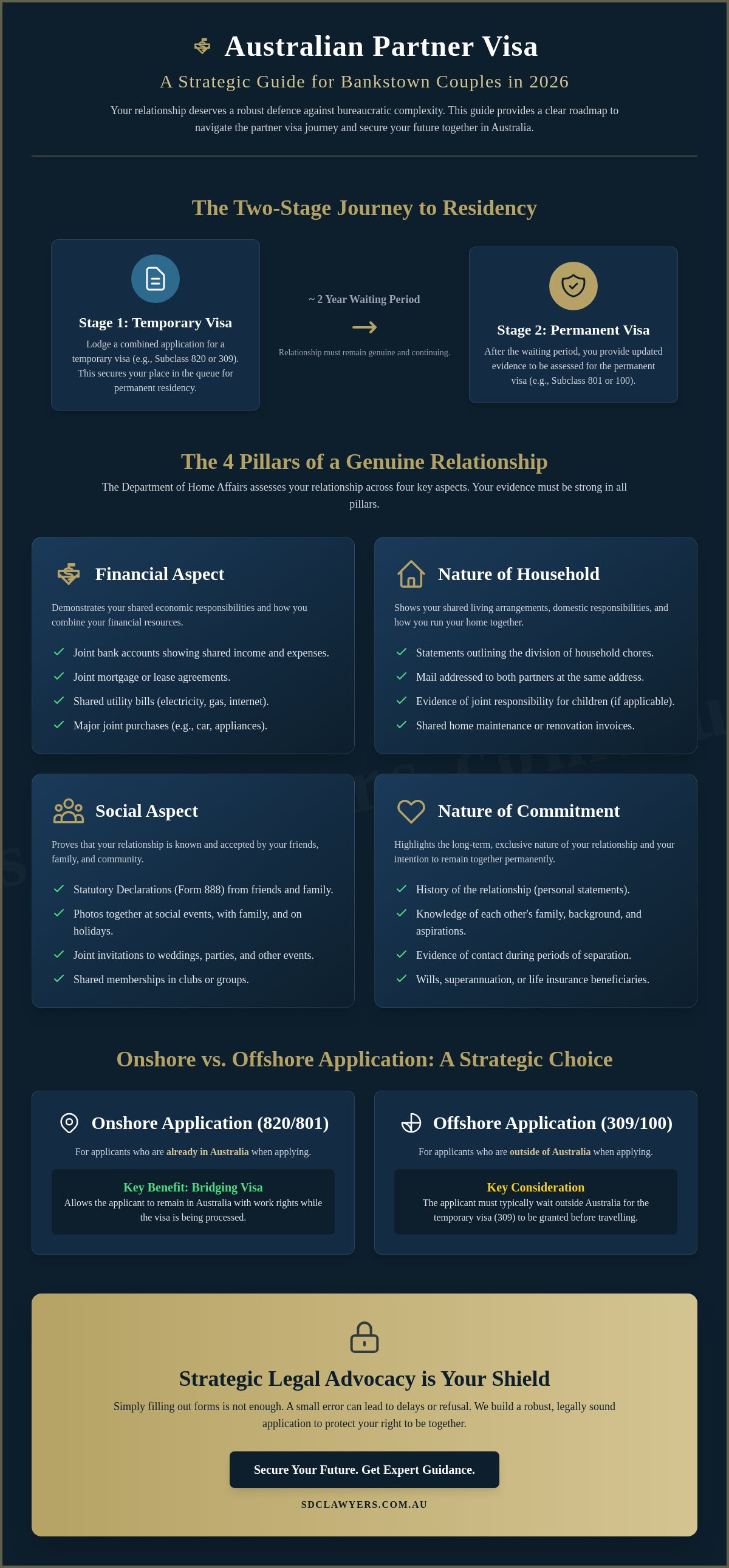
Applying for a partners visa in Bankstown involves more than just administrative paperwork. It’s a profound life event that determines where your family will build its future. The Australian Department of Home Affairs structures this process as a two-stage journey. You typically start with a temporary visa before progressing to permanent residency after a mandatory waiting period, which is generally two years from the date of your initial application. This transition requires consistent proof that your relationship remains genuine, continuing, and exclusive.
In 2026, the regulatory environment for Western Sydney applicants remains rigorous. Processing times and evidentiary requirements have evolved, making the broader Australian immigration framework more complex for those without professional guidance. At SDC Lawyers, we act as your Strategic Advocate. We understand that for Bankstown families, this isn't just a case file; it's about protecting your peace of mind and ensuring your partner can stay by your side without the threat of separation. We position ourselves as a shield between you and the bureaucratic hurdles of the Department.
Understanding the Subclass Options
The path you choose depends on where the applicant is located at the time of lodgement. The Onshore (820/801) subclasses are designed for couples already living together in Australia, providing a bridging visa that allows the applicant to stay during processing. The Offshore (309/100) subclasses apply to those currently overseas. If you aren't married yet but have firm plans to wed, the Prospective Marriage Visa (Subclass 300) provides a nine-month window to enter Australia and marry. Most applicants lodge a combined application for both the temporary and permanent stages, which secures your place in the queue for residency from day one.
The Importance of a Strategic Approach
Simply filling out forms is rarely enough to satisfy the Department's high evidentiary standards. A partners visa application requires a cohesive narrative supported by financial, social, and household evidence. A strategic legal review is vital to prevent common pitfalls, such as inconsistent dates in your relationship history or insufficient joint financial records. These small errors often lead to lengthy delays or costly appeals in the Administrative Review Tribunal. To understand the specific evidence needed for your situation, explore our pillar page on partner visa australia requirements. We focus on building a robust defence for your application, ensuring every document reinforces your right to remain together in the community you call home.
The 4 Pillars of a Genuine Relationship: A Strategic Evidence Checklist
To secure a partners visa, you must prove your relationship is genuine and continuing to the satisfaction of the Department of Home Affairs. Decision-makers evaluate your life together through four distinct lenses, often referred to as the four pillars. These categories allow the Department to look past the surface and understand the deep, functional reality of your union. At SDC Lawyers, we view this evidence gathering as a strategic defence of your future in Australia, ensuring every document serves a specific purpose in your narrative.
The Department assesses these four pillars to determine your eligibility:
- The Financial Pillar: Evidence of how you share economic responsibilities.
- The Nature of the Household Pillar: Documentation showing your shared living arrangements and domestic life.
- The Social Aspect Pillar: Proof of how your relationship is perceived by the community and friends.
- The Nature of the Commitment Pillar: Evidence of your long-term intention to remain together.
Documenting Your Financial Interdependence
Financial interdependence is the cornerstone of the application. It demonstrates that you and your partner have combined your resources and share the costs of living. While a joint mortgage is excellent evidence, many couples in the 2200 postcode area choose to rent or manage finances differently. You can still prove interdependence through consistent patterns of support.
Financial Pillar Checklist:
- Joint bank account statements showing regular household purchases like groceries and utilities.
- Evidence of joint ownership of major assets, such as a car or property.
- Joint liabilities, including personal loans or lease agreements.
- Beneficiary designations on superannuation funds or life insurance policies.
- Regular bank transfers between personal accounts with clear descriptions like "Rent Contribution February 2026."
Proving Your Shared Life in Bankstown
Your daily routine in Bankstown provides the most authentic proof of your partnership. The Department wants to see how you organize your domestic life and how you interact with the local community. Reviewing the official Partner Visa (Subclass 820/801) information confirms that household evidence is just as vital as financial records.
Nature of the Household Checklist:
- A lease agreement listing both names or statutory declarations from Bankstown neighbors confirming you live together.
- Mail from government agencies or banks addressed to both of you at the same residence.
- Personal statements describing how you divide chores, such as cooking, cleaning, and shopping.
Social Aspect and Commitment Checklist:
- Form 888s completed by Australian citizens, such as long-term friends or colleagues, who can attest to your relationship.
- Joint travel itineraries, flight tickets, and photos from significant events like weddings or family gatherings.
- Wills or binding financial agreements that name each other as primary beneficiaries.
- Evidence of future plans, such as correspondence regarding a future home purchase or starting a family.
Gathering this volume of data can feel overwhelming during an already emotional time. If you need a professional to review your documentation, our team can provide a strategic evidence assessment to ensure your application stands up to the highest level of scrutiny.
Onshore vs. Offshore: Strategic Decision Framework for 2026
Deciding where to lodge your application is the most critical tactical choice you'll make. This decision defines whether you spend the processing period building a home together in Bankstown or managing a relationship across time zones. For many, the choice is dictated by current visa status, but for those with options, a clear analysis of the 2026 migration landscape is essential. Understanding the legal framework of the partner visa scheme helps clarify why the Department of Home Affairs maintains a two-stage process for both pathways. In 2026, processing times for a partners visa typically range from 14 to 26 months, making your location during this wait a vital consideration for your mental and financial well-being.
The Onshore Advantage (Subclass 820/801)
Applying within Australia offers immediate stability. Once you lodge a Subclass 820 application, you're typically granted a Bridging Visa A (BVA). In 2026, the BVA remains a powerful tool for family unity. It provides full work and study rights, allowing you to contribute to your household and integrate into the Bankstown community immediately. You won't have to wait for a final decision to start your career or enrol in local courses. The emotional relief of staying together cannot be overstated. It eliminates the trauma of long-distance separation and allows you to gather relationship evidence naturally as you live your daily lives. SDC Lawyers manages the immigration law complexities for onshore clients, ensuring your transition from a temporary visa to the BVA is seamless and legally sound.
When Offshore (Subclass 309/100) Makes Sense
Offshore applications are often a necessity rather than a choice, yet they carry specific strategic benefits. As of early 2026, offshore processing times for the Subclass 309 visa have stabilised at approximately 16 to 20 months for a high percentage of applicants. This pathway can sometimes be more strategically sound if the applicant doesn't hold a substantive visa to enter Australia or if personal commitments require them to remain in their home country for a period. Gathering evidence from abroad requires a disciplined approach to documentation. You'll need to meticulously track communication logs, financial transfers, and travel history to prove the genuineness of the relationship. While the distance is difficult, the eventual grant of the 309 visa allows you to enter Australia with clear residency rights, providing a sense of certainty as you begin your partners visa journey together in Sydney’s southwest.
Local Logistics: Gathering Your Documentation in Bankstown
The journey toward a successful partners visa application often feels like a paper-heavy marathon. In Bankstown, your success depends on how precisely you organize your life into a digital folder. We've seen many couples struggle not with the reality of their relationship, but with the technicalities of their evidence. A strategic approach to documentation ensures that a case officer sees a clear, undeniable picture of your commitment. High-quality, colour scans are the standard in 2026; grainy or cut-off images can lead to unnecessary delays or requests for information that stall your progress.
Certified Copies and Statutory Declarations
Bankstown residents have several accessible hubs for certifying documents. The Bankstown Library and Knowledge Centre on Rickard Road offers regular Justice of the Peace (JP) services, typically on weekdays. You can also find JPs at the Bankstown Police Station on Meredith Street, though it's wise to call ahead to ensure someone is available. For identity documents in 2026, the Department requires scans that show all four corners of the original document without any digital filters. A Statutory Declaration is a legal promise of truth. When you sign this document, you're confirming that the details of your relationship history are accurate under the Statutory Declarations Act 1959.
Health and Character Checks
Timing is a critical element of your strategy. Your Australian Federal Police (AFP) check and your Bupa health examinations are generally valid for 12 months. If you complete these too early, they might expire before a case officer reviews your file, forcing you to pay for new checks. For medical exams, Bupa Medical Visa Services operates a major hub in Parramatta, which is the most convenient location for those living in the Bankstown area. You'll need to book these using your HAP ID after your partners visa application is lodged or via the "My Health Declarations" service.
Character or health red flags don't have to mean an automatic refusal. If you have a history of medical conditions or past legal infractions, these must be addressed with transparency and a clear legal argument. We recommend the following steps for digital organization:
- Create folders categorized by the "four pillars": financial, social, household, and commitment.
- Use a consistent naming convention, such as "2026_Joint_Bank_Statement_January."
- Ensure all files are under 5MB to meet the Department's upload limits.
- Keep a physical backup of every certified copy in a secure location.
Our team understands that gathering this evidence is an emotional process that requires patience and precision. If you're feeling overwhelmed by the paperwork, our team provides a strategic assessment of your documentation to ensure your application is decision-ready and robust.
Beyond the Forms: Why Strategic Legal Advocacy is Your Protective Shield
You might wonder if you can manage the partners visa process alone to save on costs. It's a common thought for couples in Bankstown who are already facing the high A$9,095 application fee. However, the Department of Home Affairs doesn't offer second chances for technical errors. A single missing document or a vague response can lead to a refusal, resulting in the loss of your application fee and a complex legal road ahead. This isn't just about filling out paperwork; it's about building a bulletproof case that survives intense scrutiny.
SDC Lawyers provides a sophisticated blend of compassionate support and tactical aggression against bureaucratic hurdles. We understand the emotional weight of your migration journey. Our role is to act as your strategic advocate, positioning ourselves as a protective shield between you and the Department. We're your local Bankstown allies, ensuring your story is told with the legal precision required to secure your future in Australia.
- We identify potential red flags in your relationship history before the Department does.
- Our team ensures every piece of evidence meets the strict "four pillars" of relationship proof.
- We manage all communication with Home Affairs, removing the stress from your daily life.
Dealing with Departmental Requests (Section 56)
If a Case Officer decides your application lacks specific evidence, they'll issue a Section 56 request. These notices typically carry a strict 28-day deadline. Missing this window or providing an inadequate response often leads to an immediate visa refusal. We manage these requests strategically by analyzing exactly what the Department is looking for and providing high-quality evidence that addresses their concerns directly. Should your case face complications, our expertise in tribunal immigration matters ensures you have a robust defense ready for the Administrative Review Tribunal.
The Peace of Mind Factor
Professional advocacy offers more than just a higher chance of success; it provides the stability you need during a high-stakes period. We're here to restore balance to your life while we handle the complexities of the partners visa system. Our firm also assists couples with broader legal planning, such as explaining the meaning of pre nuptial agreements to protect your assets as you start your new life together. Don't risk your residency on a DIY application. Reach out to our Bankstown office today for a strategic consultation and let us defend your right to stay together.
Take the Next Strategic Step in Your Australian Journey
Securing your future in Australia requires a methodical approach to the four pillars of relationship evidence and a clear decision on your 2026 application pathway. With the Department of Home Affairs application charge for a partners visa currently set at A$9,095 as of late 2024, there is no room for technical errors or missing local documentation. Our specialist immigration law team in Bankstown acts as your strategic advocate, providing a protective shield against bureaucratic complexity. We offer the compassionate support Western Sydney couples need during these high-stakes transitions. We focus on restoring balance to your life by managing the technical legalities so you can focus on your shared future. You don't have to navigate this legal wilderness alone. Our local expertise ensures your application is robust, honest, and positioned for success from the very first day. We understand the emotional weight of your journey and remain committed to seeing your case through to a positive resolution.
Book a Strategic Partner Visa Consultation in Bankstown
Frequently Asked Questions
How long does a partner visa take to process in 2026?
Most applicants for a partners visa can expect a processing timeframe of 12 to 24 months for the temporary stage based on 2026 Department of Home Affairs projections. This timeline depends on the quality of your evidence and current government caseloads. We focus on a strategic preparation phase to ensure your file is decision-ready, which helps minimize delays. Our team monitors these trends to keep your expectations realistic and your journey on track.
Can I work in Bankstown while waiting for my partner visa?
You can typically work without restrictions in Bankstown once your Bridging Visa A takes effect. This bridging visa activates after your current substantive visa expires while your partners visa application is under review. Having full work rights provides financial stability and peace of mind during the waiting period. It's a vital part of restoring balance to your life as you build a future together in the local community.
What happens if our relationship ends before the permanent visa is granted?
Your pathway to permanent residency may still be possible under specific legal provisions if the relationship ends due to family violence or if you have a child together. These situations require a sensitive, strategic approach to protect your legal entitlements. We act as your shield, navigating the complex Department rules to secure your future. You don't have to face these bureaucratic systems alone during such a stressful personal crisis.
Is it better to get married or apply as a de facto couple?
There is no legal preference between marriage and de facto relationships for visa success, as both require proof of a genuine and continuing commitment. A marriage certificate provides immediate evidence of a legal union, while de facto couples often need to demonstrate a 12 month history or register their relationship. We help you choose the path that best fits your story. Our priority is ensuring your application reflects the true depth of your partnership.
How much does a partner visa cost in Australia for 2026?
The Department of Home Affairs base application fee for a partner visa is A$9,095 as of the 2025-2026 financial year. Additional costs include health examinations, police checks, and biometrics, which can add approximately A$500 to A$1,000 to your total budget. We provide a transparent breakdown of these expenses early in our consultation. This financial clarity helps you plan your journey without unexpected surprises or added stress during the process.
Do we need to live together for 12 months before applying?
You generally need to prove a 12 month de facto relationship unless you have registered your relationship with a state or territory government. Registering a relationship in New South Wales can waive the strict 12 month cohabitation requirement for the visa application. We look at your living arrangements strategically to ensure you meet all criteria. This approach provides a solid defence against potential refusals based on the duration of your shared life.
Can SDC Lawyers help if our partner visa has already been refused?
SDC Lawyers provides robust legal advocacy for couples facing a visa refusal or cancellation. We represent clients at the Administrative Appeals Tribunal, where we challenge Department decisions with tactical precision. A refusal is a significant hardship, but it's not always the end of the road. Our team works tirelessly to find a strategic path forward, restoring hope and fighting for your right to stay together in Australia.
What is the difference between a subclass 820 and 801 visa?
The subclass 820 is a temporary visa that allows you to stay in Australia while the Department assesses your permanent residency. The subclass 801 is the permanent stage, usually granted two years after you first applied. You apply for both simultaneously in a combined application process. This two stage journey is designed to test the longevity of your commitment. We guide you through both milestones to ensure a seamless transition to permanent status.