

Imagine standing outside Bankstown Local Court on a Tuesday morning, knowing that a single magistrate's decision could end your ability to drive to work or care for your family. It's a heavy burden to carry. We understand that a robust driving offence defense is about more than just legal arguments; it's about protecting your daily life and your future. You likely feel that the current NSW traffic penalties are an overwhelming maze designed to punish rather than reform. It's a valid concern, as a single mistake shouldn't define your entire character or your livelihood.
Our firm serves as a protective shield during these high-stakes moments. This strategic guide for 2026 provides the clear path you need to navigate complex legislation and pursue a Section 10 dismissal. You'll learn how to approach your court appearance with confidence and the exact methods used to reduce or eliminate suspension periods. We'll explore the specific evidence required by the court and the tactical steps involved in restoring your peace of mind while ensuring your rights remain a priority throughout the legal process.
Key Takeaways
- Understand how a strategic driving offence defense provides a framework to challenge or mitigate charges, protecting your livelihood and your family’s future in Bankstown.
- Identify the crucial differences between summary and indictable offences and how these classifications impact the specific penalties handed down at Bankstown Local Court.
- Explore why a strategic approach prioritises the path with the highest probability of success, whether through a plea of mitigation or a formal challenge.
- Access a practical checklist for court preparation, emphasizing the vital role of early evidence collection like dashcam footage and GPS logs to strengthen your position.
- Discover how deep local legal expertise serves as a protective shield, guiding you through the complexities of the NSW justice system with confidence and empathy.
Facing a Driving Offence Charge in Bankstown: What is at Stake?
A driving offence defense is the strategic legal process used to challenge or mitigate traffic charges within the New South Wales justice system. For residents of Bankstown, a simple traffic stop can quickly escalate into a life-altering crisis. The legal framework governing our roads is complex. It relies on the foundation of the Australian Road Rules, but the local application in NSW is notoriously strict. You might face fines reaching thousands of dollars, the rapid accumulation of demerit points, or mandatory licence disqualification periods that last for years. We view our role as Strategic Advocacy. We act as a protective shield between you and a bureaucratic legal system that often prioritizes administrative efficiency over individual circumstances.
The stakes are high. NSW authorities have increased enforcement measures in 2026, making it easier than ever to lose your right to drive. This isn't just about a piece of plastic in your wallet. It's about your freedom to move, work, and provide. Our approach ensures that your side of the story is heard with clarity and professional authority.
The Immediate Impact on Your Daily Life
The industrial and commercial sectors of Bankstown rely heavily on mobility. If you work in logistics, transport, or manage a trade business near the M5 corridor, a licence suspension is a direct threat to your livelihood. Losing your ability to drive often means losing your income. For professional drivers or those currently maintaining student visa status, the stress of a potential criminal record is immense. Such a record can terminate a career path or complicate residency applications. A driving charge can destabilise a family’s long-term financial and emotional security for years to come.
Why a "Standard" Defence is Often Not Enough
Accepting a penalty notice and simply paying the fine might feel like the path of least resistance. It's often a trap. This decision can trigger secondary consequences, such as massive insurance premium hikes or a permanent mark on your driving history that affects future employment. When your matter proceeds to the Bankstown Local Court, a standard, unguided approach rarely achieves the best outcome. The court system is rigid. It requires a precise understanding of legal precedents and local court procedures.
We provide a Human-First response to these crises. We recognize that behind every case file is a person who deserves to be protected during their most vulnerable moments. Our commitment includes:
- Strategic Analysis: We examine the evidence to find procedural errors or mitigating factors.
- Court Representation: We provide a calm, confident voice before the Magistrate.
- Holistic Support: We prioritize your emotional well-being alongside your legal success.
The system doesn't have to overwhelm you. With the right driving offence defense, you can navigate this journey with peace of mind. We stand as your dedicated ally, ensuring that one mistake doesn't define your entire future.
Understanding Common NSW Traffic Offences and Penalties
In 2026, Bankstown Local Court remains one of the busiest hubs for traffic matters in Sydney's southwest. Most charges heard here fall into the category of "summary offences," which are less serious matters dealt with by a Magistrate. However, more severe "indictable offences," such as dangerous driving causing grievous bodily harm, carry significantly heavier weight and may be referred to the District Court. Understanding where your charge sits is the first step in building a driving offence defense that protects your future.
The Road Transport Act 2013 dictates the legal framework for these matters, imposing mandatory disqualification periods for many offences. This legislation leaves little room for error. While the court determines your fine or immediate suspension, the Demerit Point Scheme operates alongside these decisions. Even if a Magistrate is lenient, Transport for NSW can still suspend a licence if you exceed your point limit. To understand the specific consequences of a charge, you can use this search tool for road-related penalties and offences in NSW to see how points and fines apply to your situation.
Speeding and Reckless Driving Charges
Speeding offences in NSW are tiered based on how far over the limit you were travelling. Exceeding the speed limit by more than 30km/h triggers an automatic 3-month suspension, while exceeding it by more than 45km/h results in an immediate 6-month ban. There's a vital legal distinction between "Negligent Driving," which involves a lack of due care, and "Dangerous Driving," which requires the prosecution to prove the driving was a real danger to the public. "Magistrates at Bankstown Local Court rarely show leniency for speeding in school zones near sites like Bankstown Public School, as the safety of vulnerable pedestrians is viewed as a paramount community obligation."
DUI, Drug Driving, and Alcohol Interlock Programs
NSW law categorises drink driving based on Blood Alcohol Concentration (BAC) levels. These are split into Low Range (0.05 to 0.079), Mid Range (0.08 to 0.149), and High Range (0.150 and above). For any mid-range or high-range offence, the Mandatory Alcohol Interlock Program is usually required. This involves installing a device in your car that prevents the engine from starting unless you provide a zero-alcohol breath sample. It's also critical to know that a "Refuse Breath Analysis" charge is not a loophole; it carries the same heavy penalties as a high-range DUI, including potential prison time and long-term disqualification.
Navigating these complex categories requires a clear, methodical approach to ensure your side of the story is heard. If you're facing a court date and feel the weight of these potential penalties, we can help you find a strategic path forward to protect your livelihood.
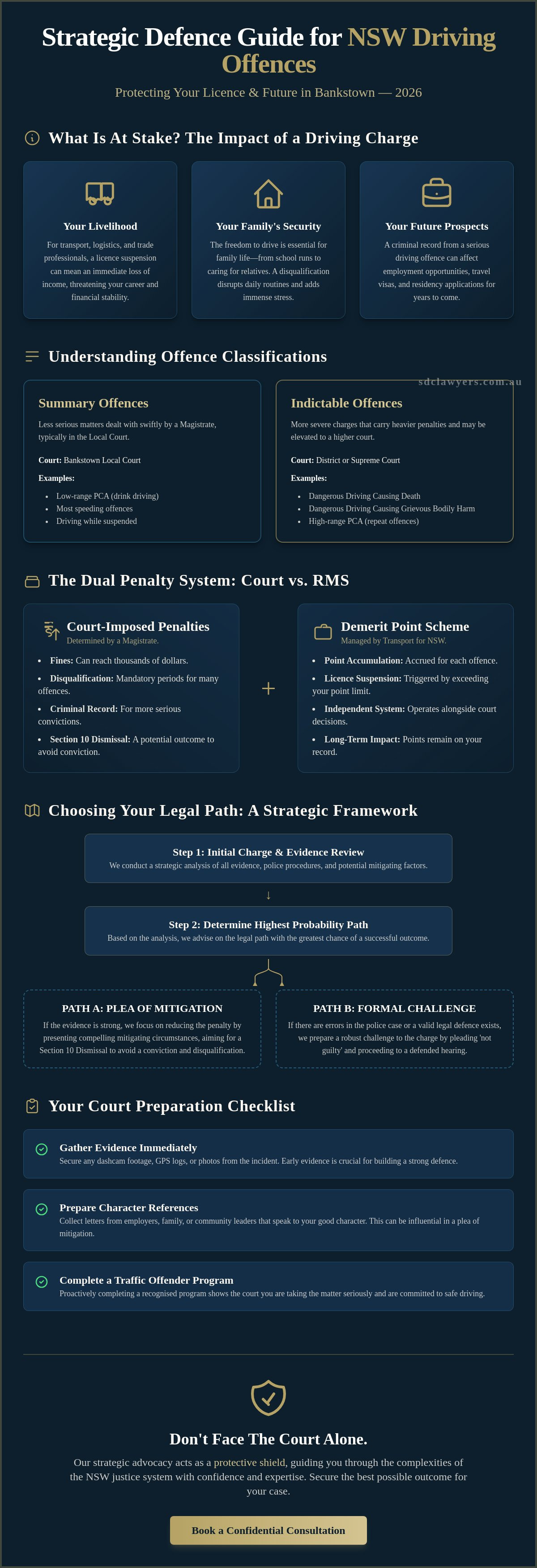
Strategic Defense Framework: Choosing Your Legal Path
Facing a charge in Bankstown doesn't mean you're out of options. A strategic driving offence defense isn't always about being aggressive in the courtroom. It's about identifying the path with the highest probability of protecting your licence and your future. In NSW, the police carry the burden of proof. They must prove every element of the charge beyond a reasonable doubt. If the evidence is flawed or the legal requirements aren't met, you shouldn't be convicted. For many first-time offenders, our primary goal is often a Section 10 Dismissal. This specific outcome allows the Magistrate to find you guilty but choose not to record a conviction. It's a powerful way to keep your record clean and your licence intact.
The Plea of Guilty: Strategies for Mitigation
If the evidence against you is strong, pleading guilty early can be a tactical advantage. This isn't a surrender; it's a controlled approach to minimize damage. We focus on humanizing you before the Magistrate. A well-crafted Letter of Apology and strong Character References show that the incident was an isolated lapse in judgment. Completing the Traffic Offender Intervention Program (TOIP) is another powerful tool. It demonstrates genuine rehabilitation and a commitment to road safety. Sometimes, personal context is vital. If you're currently navigating complex family law changes, understanding the meaning of pre nuptial agreements or custody arrangements can highlight your critical "need for licence" to support your family or fulfill legal obligations. We use these details to build a compelling narrative for leniency.
The Plea of Not Guilty: Challenging the Evidence
When the facts are in dispute, we pivot to a robust challenge of the prosecution’s case. This might involve questioning the calibration of speed detection devices or the accuracy of a police officer's visual observations. We also explore legal defences like "Honest and Reasonable Mistake of Fact." This applies if you held a genuine but mistaken belief that led to the offence. Other defences include "Necessity" or "Duress" if you were forced to drive due to an emergency. If your matter proceeds to a hearing at Bankstown Local Court, you'll need to be prepared for cross-examination. Understanding the rules for Attending Court for Traffic Matters is essential to ensure you feel confident throughout the process. We stand as your protective shield, ensuring your side of the story is heard with clarity and impact. Our goal is to provide stability during this stressful journey, ensuring the law works for you, not against you.
How to Prepare Your Defense for Bankstown Local Court
Facing a Magistrate at Bankstown Local Court can feel like standing in the middle of a storm. We understand the weight of this moment. Our role is to provide a sense of stability while building a robust driving offence defense that protects your future. Preparation starts weeks before your court date. It begins with understanding that a "Mention" is not the same as a "Hearing." A Mention is a brief procedural appearance where you enter a plea or set a timeline. A Hearing is the formal trial where evidence is tested. Knowing this distinction helps lower the initial anxiety of your first appearance.
First impressions carry immense weight in the Bankstown registry. Magistrates handle dozens of matters daily; they value efficiency and respect. We advise all clients to dress professionally and arrive 30 minutes early. This punctuality signals that you take the court's time and the gravity of the charges seriously. Evidence like dashcam footage or GPS logs must be secured immediately. Digital data can be overwritten in as little as 24 hours, so preserving this proof is a priority for any strategic defense.
Step 1: Gather Critical Documentation
Your legal strategy is only as strong as the paper trail supporting it. You'll need a certified copy of your driving record from Transport for NSW, proof of employment to demonstrate the necessity of a licence, and character references. A reference shouldn't just say you're a "good person." It must acknowledge the specific charges and explain why the offence was out of character. Effective evidence triage involves focusing exclusively on facts that prove your specific legal point rather than providing a general history of your driving. This clarity ensures the Magistrate sees the most relevant information first.
Step 2: Engage in Rehabilitation Programs
Proactive change is a cornerstone of our approach. Enrolling in an accredited NSW Traffic Offender Program (TOP) before your court date is a powerful signal of genuine remorse. These programs, often running over six to eight weeks, educate drivers on road safety and the consequences of negligence. Completing this early allows us to present a certificate of achievement to the court, showing you've already taken steps to self-correct. This aligns with our "Strategic Advocacy" model; we don't just react to the prosecution, we prepare the ground for a more favourable outcome by demonstrating your commitment to better driving habits.
If you're worried about how your history will look to a Magistrate, we can help you build a strategic driving offence defense that prioritises your right to stay on the road.
Strategic Advocacy: How SDC Lawyers Protects Your Future
Facing a court date for a traffic matter in Bankstown feels like standing alone against a massive, impersonal machine. SDC Lawyers acts as your protective shield. We manage the friction between you and the NSW legal system, ensuring your voice is heard and your rights are upheld. Our approach to driving offence defense isn't just about reading the law; it's about understanding the person behind the wheel. We operate on a human-first philosophy. This means we defend your character and your livelihood, not just the technical charge on the police sheet. A single mistake on the road shouldn't dismantle your entire future.
Why a Bankstown Local Specialist Matters
Bankstown Local Court has its own specific rhythm and procedural expectations. Our team has spent years navigating these specific corridors. We understand the nuances of how local magistrates view different traffic violations and what specific rehabilitation programs, like the Traffic Offender Intervention Program (TOIP), carry the most weight during sentencing in 2026. This local insight is vital for high-stakes cases. We frequently provide guidance for partner visa australia holders who are in a vulnerable position. For these individuals, a criminal conviction isn't just a fine or a suspension; it's a direct threat to their residency status and family stability. We also believe in financial clarity. SDC Lawyers provides a transparent, fixed-fee structure for most driving matters, so you can focus on your case instead of worrying about escalating legal bills.
Secure Your Peace of Mind Today
Our identity as a Strategic Advocate means we bring two distinct skill sets to your case. In the courtroom, we're sharp, tactically aggressive, and focused on the win. During our private consultations, we're patient and empathetic. We know that the stress of a potential licence loss can affect your sleep, your job, and your relationships. Our goal is to restore balance to your life by providing a clear, methodical path forward. We take the complexity of the 2026 NSW road rules and translate them into a logical plan of action. You aren't just another file number to us; you're a member of our community who deserves a robust defence. Don't let uncertainty dictate your future. Contact SDC Lawyers for a Strategic Consultation and let's begin the process of protecting your licence today.
Take Control of Your Legal Journey Today
Your driver's licence is more than just a piece of plastic; it's your lifeline to work, family, and independence in Western Sydney. Facing a charge in 2026 means navigating a rigid NSW legal system where a single conviction can result in a licence disqualification lasting 12 months or longer. We've detailed how thorough preparation for Bankstown Local Court and a clear understanding of traffic penalties are the first steps toward a successful outcome. A robust driving offence defense requires more than just showing up. It demands a methodical framework that prioritises your future and your emotional well-being.
At SDC Lawyers, we specialise in matters appearing before Bankstown Local Court. Our unique "Strategic Advocacy" approach ensures you aren't just another case number. We act as a protective shield, combining sharp courtroom tactics with compassionate, human-first support to help you navigate this crisis. We're committed to restoring balance to your life by providing a clear, strategic path forward through the legal wilderness.
Book a Strategic Consultation with SDC Lawyers in Bankstown
You don't have to carry this burden alone, and we're ready to help you secure the best possible result for your future.
Frequently Asked Questions
Can I avoid a criminal record for a driving offence in NSW?
You can avoid a criminal record through a Section 10 dismissal, which means the court finds you guilty but doesn't record a formal conviction. This outcome is a vital component of a strategic driving offence defense to protect your future employment and travel opportunities. We focus on presenting your character and the specific circumstances of the event to help the Magistrate exercise this discretion.
How much does a driving offence lawyer in Bankstown cost?
Legal fees for a traffic matter in Bankstown vary based on case complexity and the experience of your advocate. While we provide transparent cost disclosures tailored to your journey, the Law Society of NSW notes that hourly rates for suburban solicitors typically range from A$300 to A$600. Some firms offer fixed-fee arrangements for mentions. We prioritize your peace of mind by ensuring you understand every financial commitment before we begin.
What happens if I lose my licence and need it for work?
If you rely on your licence for work, you may be eligible to appeal a suspension or seek a sentence that keeps you on the road. The court evaluates the impact of a disqualification on your livelihood under the Crimes (Sentencing Procedure) Act 1999. We act as your protective shield, gathering evidence of your professional requirements to present a compelling case for why your licence is essential for your family's stability.
Is it worth fighting a speeding ticket in court?
Fighting a speeding ticket is often worth the effort if the demerit points will trigger a total suspension of your driving privileges. Statistics from the NSW Bureau of Crime Statistics and Research show that a well-prepared driving offence defense can result in reduced penalties or dismissed charges. We analyze technical evidence and calibration records of detection devices to identify procedural errors that might invalidate the fine.
What is a Section 10 dismissal and how do I get one?
A Section 10 dismissal is a court order where the magistrate finds you committed the offence but decides not to record a conviction. You can seek this under the Crimes (Sentencing Procedure) Act 1999 by demonstrating good character and a low risk of reoffending. It's a strategic path forward that requires detailed preparation of references and evidence of your need for a clean record to maintain your career.
How long does a driving offence stay on my record in NSW?
Most driving offences remain on your criminal record for 10 years before they become spent under the Criminal Records Act 1991. This means the conviction is no longer visible on standard background checks if you haven't reoffended during that decade. However, your driving history maintained by Transport for NSW is a separate record that authorities can access during future court proceedings to determine your traffic history.
Can SDC Lawyers help me if I have already been disqualified?
SDC Lawyers can help you navigate the process of removing a disqualification if you've met the required offence-free period. Under Section 221 of the Road Transport Act 2013, drivers who have stayed out of trouble for 2 or 4 years, depending on their specific record, can apply to the court for relief. We provide the stamina and expertise needed to restore balance to your life and get you back behind the wheel.
Do I need to attend Bankstown Local Court in person for a traffic matter?
You should plan to attend Bankstown Local Court in person for most traffic matters to show the Magistrate you take the situation seriously. While written pleas are possible for minor infringements, your physical presence allows us to advocate for you more effectively. The court is located at the Corner of Chapel Road and The Mall, and appearing in person often leads to more favourable outcomes than a remote submission.