

Imagine sitting in your home in Bankstown, watching the clock and wondering if the next hour will bring peace or another confrontation. You know things need to change, but the fear of retaliation often feels heavier than the situation itself. It's common to feel paralyzed when your safety, your family, and even your visa status are all on the line at once. You shouldn't have to choose between your security and your legal rights while navigating these high stakes alone.
We understand that the legal system can feel like an intimidating maze, especially when you're trying to distinguish between a police intervention and a private legal suit. This guide provides a strategic path through the complexities of domestic violence laws in NSW as they stand in 2026. You'll gain a clear understanding of the legal steps available to protect your household and ensure your voice is heard in the courtroom.
Our focus is on restoring your peace of mind by providing a robust legal defence against uncertainty. We'll explore the specific protections available to Bankstown residents, including how to safeguard your residency status and move forward with quiet confidence. This is your journey toward safety, and we're here to provide the stability you need to see it through to the end.
Key Takeaways
- Understand the 2026 evolution of NSW law, which now integrates coercive control frameworks into the legal definition of domestic violence to offer broader protection.
- Learn how to engage with the Bankstown Police Area Command and the Local Court system to secure urgent Apprehended Domestic Violence Orders (ADVOs).
- Discover the critical intersection between safety and legal status, including how violence findings influence parenting orders and Australian partner visas.
- Identify the strategic legal pathways available to restore balance and provide a protective shield during your journey toward long-term security.
What is Domestic Violence? Understanding the NSW Legal Definition
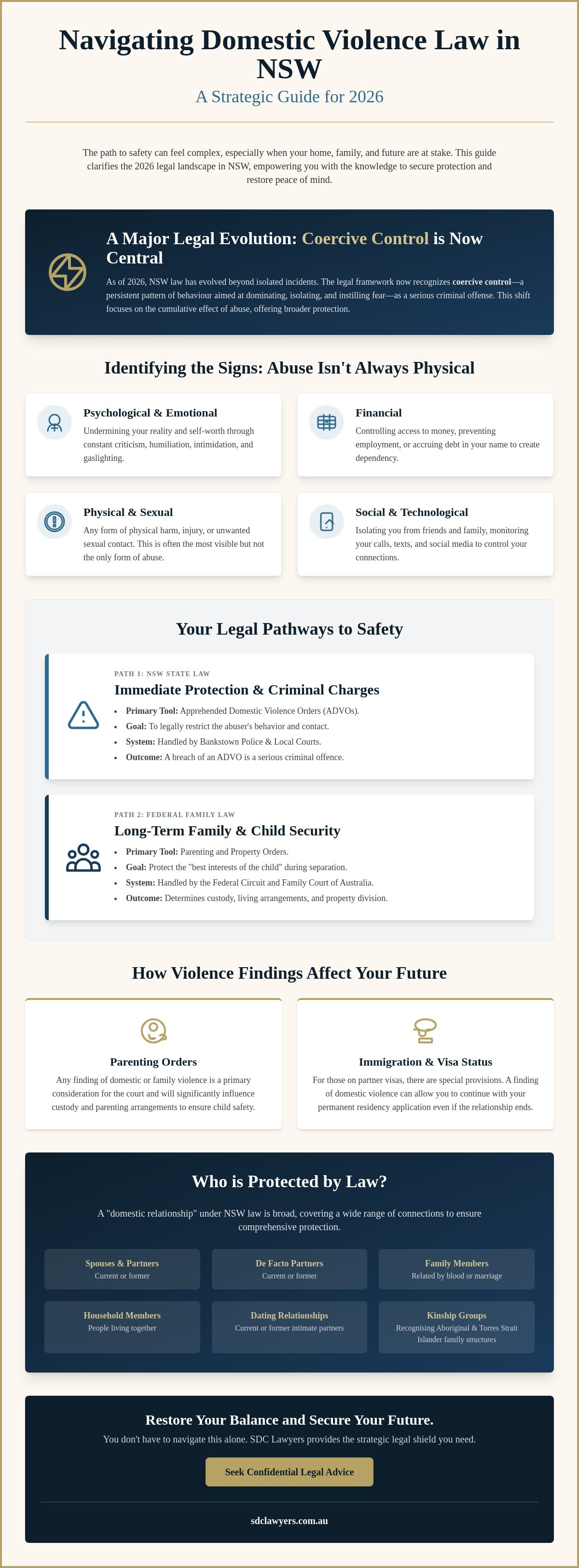
Domestic violence isn't just a private matter; it's a complex legal issue governed by the Crimes (Domestic and Personal Violence) Act 2007. At SDC Lawyers, we view our role as a strategic shield, helping you understand how these laws apply to your specific safety. By 2026, the NSW legal landscape has matured to recognize that abuse isn't always marked by physical bruises. The law now places significant weight on coercive control, which involves a pattern of behavior designed to isolate, humiliate, or restrict your personal freedom.
The historical and social context of domestic violence in Australia highlights a shift toward recognizing these non-physical patterns as serious criminal offenses. This evolution means the 2026 framework focuses on the cumulative effect of a perpetrator's actions rather than looking at isolated incidents in a vacuum. It's vital to distinguish between a criminal charge, which the police pursue to punish an offender, and an Apprehended Domestic Violence Order (ADVO). An ADVO is a civil protection order intended to keep you safe by restricting the other person's behavior, though breaching it remains a serious criminal matter.
The Legal Meaning of a "Domestic Relationship"
For a situation to be classified as domestic violence under NSW law, the parties must share a specific connection. This includes current or former spouses and de facto partners, but the scope is much wider. It covers family members, people living in the same household, and those in dating relationships. NSW legislation also provides vital recognition for Aboriginal and Torres Strait Islander kinship groups, ensuring the law reflects diverse cultural family structures.
Whether you're currently living with a partner or you've been separated for years, the law still offers protection. Our strategic approach ensures that every client feels heard, regardless of how long ago the relationship ended or the specific nature of the household arrangement.
Family Violence vs. Domestic Violence: Is there a difference?
Bankstown residents often find themselves at the intersection of two different legal systems. While NSW state law handles domestic violence through the local police and courts, the Federal Family Law Act 1975 uses the term "family violence." This federal definition is intentionally broad to protect children and parents during custody or property disputes. It includes any behavior that coerces or controls a family member or causes them to be fearful.
- State Law (NSW): Focuses on immediate protection (ADVOs) and criminal prosecution.
- Federal Law (Australia): Focuses on the "best interests of the child" in the Federal Circuit and Family Court of Australia.
Navigating both jurisdictions requires a tactical mind. Because Bankstown is a central hub for legal services in Western Sydney, understanding how a local ADVO might impact your parenting orders in the federal system is essential for restoring balance to your life.
Identifying the Signs: The Different Forms of Domestic Abuse
Recognising domestic violence requires looking past physical injuries. While physical and sexual violence are the most visible forms, they often represent only a fraction of the abuse. By 2026, legal frameworks in New South Wales have evolved to acknowledge that abuse is a calculated system of power rather than isolated outbursts. Psychological torment, such as gaslighting and constant humiliation, erodes a person's sense of reality and self-worth. Financial deprivation is equally crippling; it involves controlling access to bank accounts or sabotaging employment to ensure total dependency. Social isolation completes this trap by monitoring mobile phones and restricting movement, effectively cutting off your support network when you need it most.
Recognising Coercive Control
Coercive control is a strategic pattern of behaviour designed to dominate every aspect of your life. It's not about a single argument; it's about a sustained campaign of fear. In the current 2026 landscape, technological abuse has become increasingly sophisticated. Digital stalking through shared smart home devices, GPS tracking, and AI-driven monitoring software are now common tools used to maintain control. Documenting these patterns is a strategic necessity for your legal case. Keeping a secure, hidden log of these incidents helps build the evidentiary foundation required for a successful legal defence. The National Domestic Violence Commission provides updated resources on how these patterns impact national safety standards and legal definitions. If you feel trapped by these invisible barriers, our team can help you protect your future through clear, strategic legal pathways.
The Impact on Children and Household Members
Witnessing abuse is legally recognised as a direct form of harm to children under New South Wales law. The emotional trauma experienced by household members isn't a side effect; it's a core component of the violence. In NSW, professionals like teachers and doctors are bound by mandatory reporting requirements under the Children and Young Persons (Care and Protection) Act 1998. This law ensures that children at risk of significant harm are identified and protected by authorities. We work to safeguard all vulnerable household members by advocating for secondary inclusions in an Apprehended Domestic Violence Order (ADVO). This ensures that your children and other residents receive the same level of legal protection as you, creating a comprehensive shield for your entire home. Protecting your family starts with identifying these patterns early and seeking a strategic advocate who understands the high stakes involved.
Navigating ADVOs and the Bankstown Local Court System
An Apprehended Domestic Violence Order (ADVO) acts as a legal shield, designed to protect individuals from future violence, threats, or harassment. In our local community, the Bankstown Police Area Command plays a pivotal role in this process. When officers attend a scene and suspect domestic violence has occurred, they often issue a provisional ADVO immediately. This provides urgent protection before the matter even reaches a magistrate. You don't have to wait for a court date to feel secure; the police have the authority to act on your behalf during a crisis.
There are two primary paths to obtaining an order. Police-initiated applications are the most common, where the NSW Police Force acts as the applicant to protect a person in need. Private-initiated applications occur when an individual applies directly through the Bankstown Local Court registrar. While both paths lead to the same legal protection, police-led matters often move faster in emergency situations. When your case is listed at Bankstown Local Court, the first appearance is known as a "mention." This is a brief hearing where the magistrate determines if the defendant agrees to the order or if the case needs to be set for a future hearing.
The ADVO Process: From Application to Final Order
The journey toward long-term safety often begins with an interim order. This temporary measure ensures you're protected while the legal process unfolds. Every ADVO contains "Standard Conditions" that prohibit the defendant from assaulting, threatening, or stalking you. We often advocate for "Additional Conditions" tailored to your specific needs, such as prohibiting the defendant from approaching your home in Bankstown or your place of work. During the court mention, our strategic approach ensures these conditions are robust enough to provide genuine peace of mind.
Breaching an ADVO: Legal Consequences
Violating any condition of an ADVO is a serious criminal offence under Section 14 of the Crimes (Domestic and Personal Violence) Act 2007. If an order is breached, the police can arrest the defendant immediately. Convictions for breaching an order can lead to a fine of up to A$5,500 or two years imprisonment. At SDC Lawyers, we act as a protective layer for our clients, ensuring that any violation is documented and addressed with legal precision. If you're facing a breach, we provide the strategic guidance necessary to restore your safety and hold the responsible party accountable. Our focus remains on your stability and the integrity of the protection order throughout the litigation process.
- Interim Orders: Provide immediate, temporary protection.
- Mandatory Conditions: Prohibit violence, stalking, and intimidation.
- Strategic Advocacy: SDC Lawyers ensures your voice is heard in the Bankstown Local Court.
The Impact on Family Law and Immigration Status
Legal challenges rarely exist in isolation. When domestic violence enters a household, it often triggers a complex chain reaction that affects both your family law standing and your right to remain in Australia. We understand the paralyzing fear that comes with these overlapping crises. Our role is to act as your strategic shield, ensuring that your safety and your future residency are protected simultaneously.
Domestic Violence and Parenting Arrangements
The Australian legal landscape shifted significantly on 6 May 2024, when the Family Law Amendment Act 2023 took effect. This legislation removed the previous presumption of "equal shared parental responsibility." Now, the court's sole priority is the best interests of the child, with a heavy emphasis on safety from domestic violence. If there are findings of abuse, the court will not hesitate to order supervised contact or, in high-risk scenarios, no contact at all.
We also look at the broader financial context of your relationship. While prenuptial agreements are often viewed as purely financial documents, they provide essential context for financial history during settlements. In cases involving abuse, we strategically use these records to highlight financial control or coercion, ensuring the court sees the full picture of the relationship's history.
Visa Holders and the Family Violence Provision
Perpetrators often use the threat of deportation as a tool of control. It's a common tactic, but it's one the Australian government recognizes. You don't have to stay in an abusive relationship to keep your visa. The Department of Home Affairs has specific family violence provisions designed to protect you. These provisions allow individuals on a Partner Visa Australia pathway to continue their application for permanent residency even if the relationship has ended due to violence.
These protections aren't limited to partner visas. They also extend to Student Visa holders who are secondary applicants on their partner’s visa. To succeed, you need to provide specific evidence. This typically includes:
- Court orders, such as a final Apprehended Domestic Violence Order (ADVO).
- Medical reports or hospital records detailing injuries.
- Statutory declarations from social workers, psychologists, or domestic violence support services.
- Police statements or witness testimonies.
Strategic coordination is vital. The evidence used in your family law matter often serves as the foundation for your immigration claim. We manage these two pathways in tandem, ensuring your statements are consistent and your legal protections are airtight. You deserve a future free from fear and a secure place to call home.
If you're worried about your visa status or your children's safety, don't wait for the situation to escalate. Reach out to our team for a confidential legal consultation to secure your rights today.
Strategic Legal Support: How SDC Lawyers Protects Bankstown Residents
Facing a legal crisis is a deeply personal experience that demands more than just technical advice. At SDC Lawyers, we adopt a human-first approach to every case. We recognize that individuals dealing with domestic violence are often at their most vulnerable. Our role is to serve as a protective shield, standing between you and the overwhelming pressure of the NSW justice system. We don't view you as a file number; we see a person whose peace of mind and safety are at stake.
A Strategic Advocate is vital when your future is on the line. The legal landscape in New South Wales is intricate, often requiring a dual focus on both criminal law and family law. Our team integrates these disciplines to ensure your strategy is cohesive. If an Apprehended Domestic Violence Order (ADVO) is in place, it directly impacts parenting arrangements and property settlements. We coordinate these moving parts to prevent conflicting outcomes, providing a clear and methodical path toward restoring balance in your life. Our firm acts with the stamina and expertise required to see your matter through to a resolution that prioritizes your long-term security.
Your First Consultation: What to Bring and Expect
Your initial meeting is a confidential sanctuary where your story is heard without judgment. Legal professional privilege ensures that everything you share remains protected, creating a safe space to discuss the details of your situation. To help us build a robust defense of your rights, we recommend gathering specific documentation if it's safe to do so. This includes:
- Police event numbers or copies of existing ADVO applications.
- Medical records or reports from facilities like Bankstown-Lidcombe Hospital.
- Digital logs, including dated screenshots of text messages or call histories.
- A list of any upcoming court dates or mediation sessions.
We use these facts to develop a comprehensive safety plan that runs parallel to your legal proceedings. We'll discuss immediate protections, such as interim orders, to ensure you feel secure the moment you leave our office.
Why Local Expertise in Bankstown Matters
Our deep roots in the Bankstown community provide a distinct tactical advantage. We've built professional relationships with the registry staff and legal practitioners at the Bankstown Local Court on Chapel Road. This local familiarity allows us to navigate the court's specific listing preferences and procedural nuances efficiently. We understand the diverse cultural fabric of our region and tailor our communication to meet the unique needs of every client. Justice shouldn't be a distant concept; it should be accessible and local. We're committed to providing the residents of Bankstown with a steady, calm, and deliberate legal journey. Secure your future with SDC Lawyers and let us guide you through the legal wilderness with confidence and resilience.
Securing Your Future and Legal Safety
Navigating the complexities of the Crimes (Domestic and Personal Violence) Act 2007 requires more than just legal knowledge; it demands a tactical approach tailored specifically to the Bankstown Local Court system. You've seen how identifying the diverse forms of domestic violence is the first step toward reclaiming your independence and safety. Whether you're managing the strict requirements of an ADVO or navigating the significant 2024 reforms to the Family Law Act, you don't have to face these high-stakes hurdles alone.
Our team provides specialised expertise at the critical intersection of family and immigration law, ensuring your residency remains secure while you seek protection. We prioritise your emotional well-being through a human-first approach, acting as a strategic shield between you and complex legal systems. With our deep local experience and commitment to justice, we help you build a robust defence for your future. It's time to move from a state of crisis to a position of strength. Book a confidential strategic consultation with our Bankstown team to begin your journey toward lasting peace of mind.
Frequently Asked Questions
What is the first thing I should do if I am experiencing domestic violence in Bankstown?
Your immediate safety is the absolute priority. If you're in danger right now, call 000 immediately to reach emergency services. For non-urgent support, you can contact Bankstown Police Station at 02 9783 2199 or visit them at the corner of Chapel Road and The Mall. Seeking early legal advice helps you build a strategic plan to protect your future. We act as a shield during this transition, ensuring you have the support needed to navigate the system safely.
Can I get an ADVO without the police being involved?
You can apply for a private Apprehended Domestic Violence Order (ADVO) through the Bankstown Local Court Registry without involving the police. This process involves filing a formal application and appearing before a Magistrate to explain why you fear for your safety. While the police aren't required to start the process, having a legal advocate ensures your application is drafted with the precision required to secure your protection. It's a path that gives you control over your legal journey while maintaining your privacy.
Will I lose my partner visa if I report domestic violence against my sponsor?
You won't automatically lose your visa if you report domestic violence against a sponsoring partner. The Australian government provides specific protections under the Migration Act 1958 known as the family violence provisions. These allow eligible visa applicants to continue their permanent residency claim even if the relationship has ended due to abuse. It's a vital safety net that ensures your immigration status isn't used as a tool of control by a perpetrator.
How much does it cost to get legal help for a domestic violence case?
Legal costs for domestic violence matters vary based on the complexity of your case and whether you're eligible for Legal Aid NSW. Private legal fees are typically structured as fixed fees for court appearances or hourly rates for preparation work. We prioritize transparency and accessibility in our fee structures to ensure you can focus on your recovery rather than financial stress. Many firms offer initial consultations to help you understand the potential financial path forward without hidden surprises.
What is coercive control and is it illegal in NSW in 2026?
Coercive control is a pattern of behavior used to dominate a partner through fear and manipulation, and it's fully illegal in NSW. This legislation, which came into effect in July 2024 under the Crimes Legislation Amendment (Coercive Control) Act 2022, carries a maximum penalty of seven years in prison. It recognizes that abuse isn't always physical. It includes monitoring your movements, restricting your finances, or isolating you from family. This law provides a strategic tool to prosecute abusers who use psychological warfare.
How does domestic violence affect child custody in Australia?
The Family Law Act 1975 mandates that the court's primary consideration is the best interests of the child, with safety being the paramount factor. Evidence of violence can significantly impact parenting orders, often resulting in supervised contact or restricted access for the perpetrator. The court aims to protect children from physical or psychological harm above all else. We work to ensure the court hears the full truth of your family’s situation to keep your children secure and restore balance to your lives.
Can an ADVO be taken out against me if I didn’t hit anyone?
An ADVO can be issued against you even if no physical contact occurred, as the law covers intimidation, stalking, and harassment. If a person fears for their safety or believes you're engaging in a pattern of controlling behavior, a court can grant an order to protect them. These legal protections are designed to prevent violence before it escalates. Understanding the specific allegations is the first step in building a robust defence for your reputation and your rights.
What happens at a Bankstown Local Court mention for domestic violence?
A mention is the first time your case appears before a Magistrate at Bankstown Local Court, located at the corner of Chapel Road and The Mall. It's a brief administrative hearing where you inform the court if you're pleading guilty, not guilty, or if you need an adjournment to seek legal advice. The Magistrate might also make interim orders to ensure immediate safety while the case progresses. Having a strategic advocate by your side during this first appearance provides the calm clarity needed in a high-pressure environment.